What Is AI Visibility?
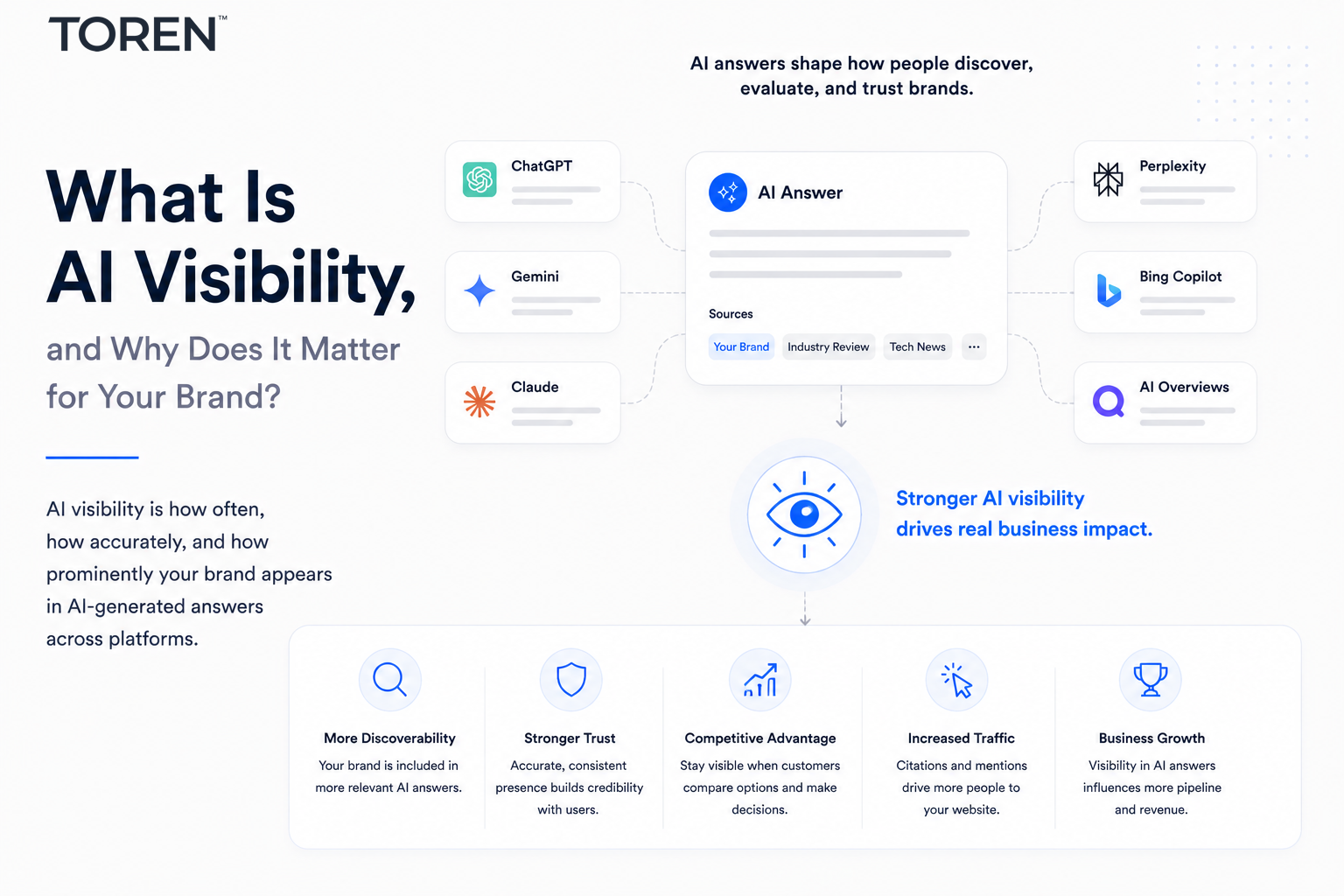
AI visibility is the measure of how often, how accurately, and how favorably a brand appears in AI-generated answers.
As people use tools like ChatGPT, Gemini, Claude, Perplexity, and AI-powered search experiences to research products, compare vendors, and make decisions, brands are no longer competing only for traditional search rankings. They are also competing for inclusion inside AI-generated responses.
In traditional SEO, visibility usually means showing up in search results. In AI systems, visibility means something different. It means whether your brand is mentioned, recommended, cited, compared, or accurately understood when someone asks an AI system a relevant question.
A brand can rank well in search and still be missing from AI answers. A competitor can appear in an AI-generated recommendation even when they are not the strongest company in the category. An AI system can also misunderstand what a brand does, omit important products, cite outdated sources, or describe a company in ways that do not match its actual positioning.
That is why AI visibility is becoming an important part of modern brand, search, and content strategy.

Why AI Visibility Matters
AI-generated answers are changing how people discover information.
A buyer may no longer start with a list of search results. Instead, they may ask:
- “What are the best platforms for monitoring AI visibility?”
- “Which agencies help local businesses improve online presence?”
- “What are the top alternatives to [competitor]?”
- “Which brands are leaders in [category]?”
- “What should I consider before choosing a vendor for [problem]?”
In each case, the AI-generated answer can shape perception before a user ever visits a website.
That answer may introduce a brand, exclude a brand, recommend a competitor, summarize a category, or cite specific sources. For many teams, this creates a new strategic question:
Is our brand showing up when AI systems answer the questions our customers are asking?
That is the core of AI visibility.
AI Visibility Is Not the Same as SEO
AI visibility and SEO are related, but they are not the same.
SEO focuses on how well pages perform in traditional search engines. It often includes keyword rankings, organic traffic, technical performance, backlinks, and content optimization.
AI visibility focuses on how brands appear inside generated answers. It includes brand mentions, recommendations, citations, competitor comparisons, answer accuracy, and whether AI systems understand the brand’s role in a category.
A page may rank in Google but not be used in an AI-generated answer. A brand may have strong organic traffic but still be absent when AI systems recommend vendors. A company may have content on its site, but if that content is unclear, inconsistent, or unsupported by external authority signals, AI systems may not understand it well.
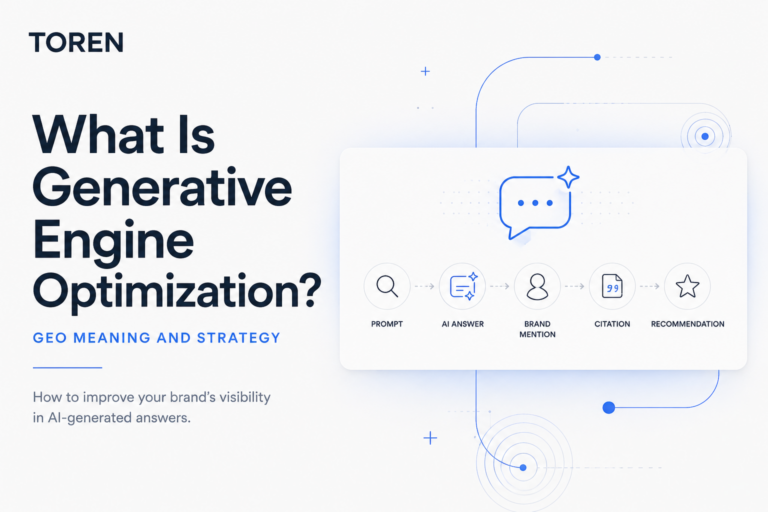
This is where Generative Engine Optimization becomes relevant. GEO is the practice of improving how brands and content are understood, surfaced, and cited by AI-generated answer systems.
Learn more about Generative Engine Optimization →
What AI Visibility Measures
AI visibility is not just one metric. It is a collection of signals that help explain how a brand appears across AI-generated answers.
Common AI visibility signals include:
Brand mentions
Does the AI system mention your brand when answering relevant prompts?
For example, if someone asks for leading software providers, local experts, agencies, products, or services in your category, does your brand appear in the answer?
Recommendation presence
Is your brand simply mentioned, or is it actually recommended?
There is a meaningful difference between appearing in a list and being described as a strong option.
Competitive inclusion
Which competitors appear alongside you?
AI visibility is often relative. If your brand is absent but competitors are consistently included, that is a competitive intelligence signal.
Citation presence
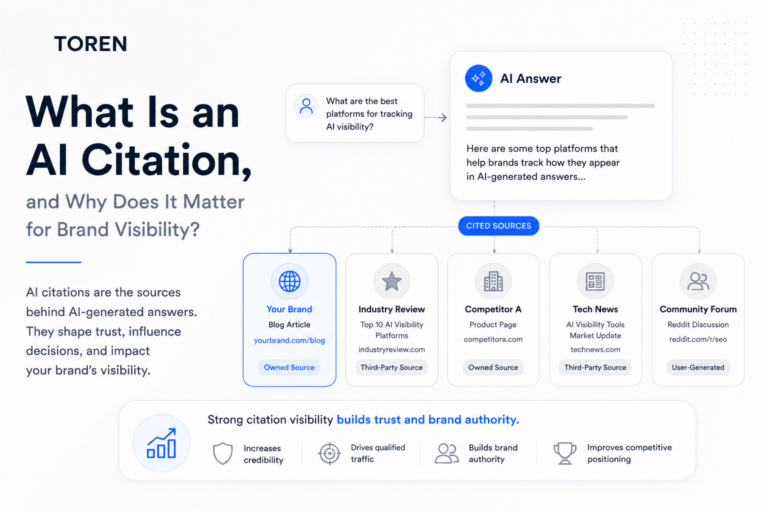
When an AI system provides sources, does it cite your website, third-party articles, review platforms, partner pages, or other relevant sources?
Citations matter because they help show which sources are influencing the generated answer.
Learn more about AI Citations →
Answer accuracy
Does the AI system describe your brand correctly?
A brand may appear in an answer but still be miscategorized, described with outdated language, associated with the wrong products, or confused with a different company.
Sentiment and positioning
Is your brand described as credible, specialized, established, innovative, affordable, enterprise-ready, local, premium, or something else?
AI-generated answers do not just mention brands. They often frame them.
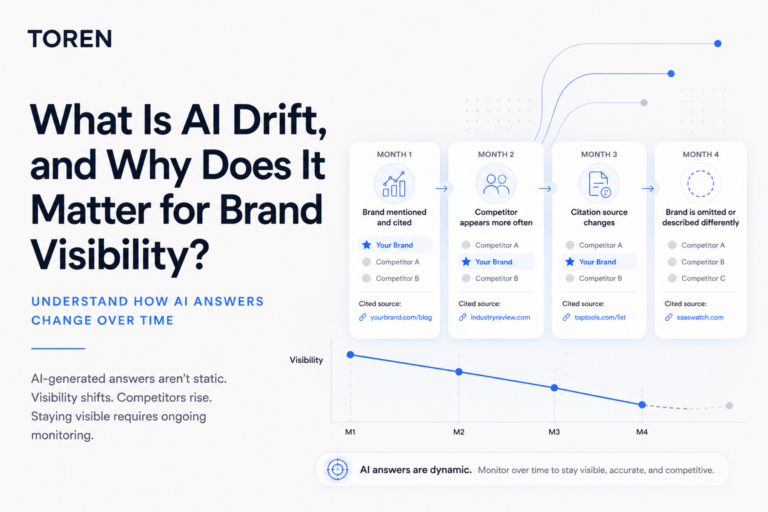
Drift over time
Do answers change from one run to the next?
AI visibility is not static. A brand may appear one month, disappear the next, or be replaced by a competitor as models, sources, and answer patterns change.
Learn more about AI Drift →
Why Brands May Be Missing from AI Answers
A brand can be strong in the real world and still have weak AI visibility.
This usually happens because AI systems depend on patterns, sources, context, and clarity. If those signals are incomplete or inconsistent, the brand may not be included.
Common reasons a brand may be missing include:
The brand is not clearly associated with the category
If a company does not clearly explain what it does, who it serves, and which problems it solves, AI systems may struggle to connect it to relevant prompts.
The content is too vague
Generic website copy can make it harder for AI systems to understand the brand’s specific expertise. Phrases like “innovative solutions” or “full-service partner” may sound polished to humans but provide little concrete context.
Competitors have stronger supporting content
A competitor may have clearer comparison pages, better FAQs, stronger third-party mentions, more specific use cases, or more content aligned to buyer questions.
The brand lacks authoritative sources
AI systems may rely on a mix of brand-owned content and external signals. If a brand is rarely mentioned by credible third-party sources, it may be less likely to appear in generated recommendations.
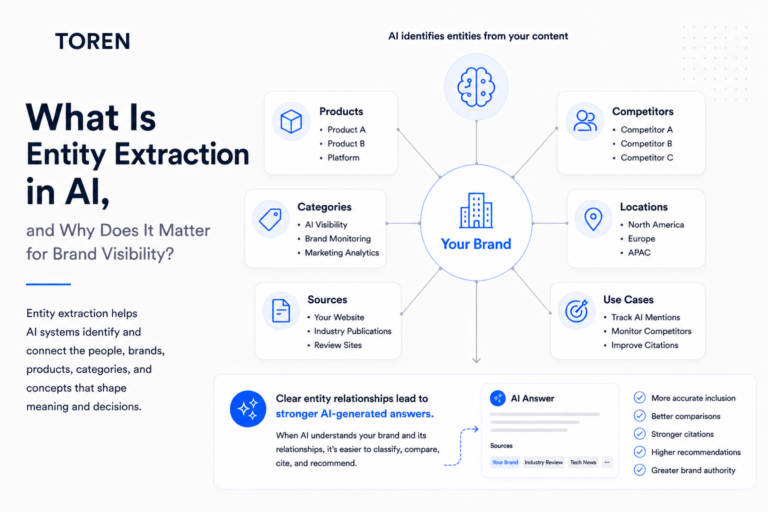
The brand entity is unclear
AI systems need to understand that a brand is a distinct entity. Confusion can happen when a brand name overlaps with common words, other companies, products, locations, or categories.
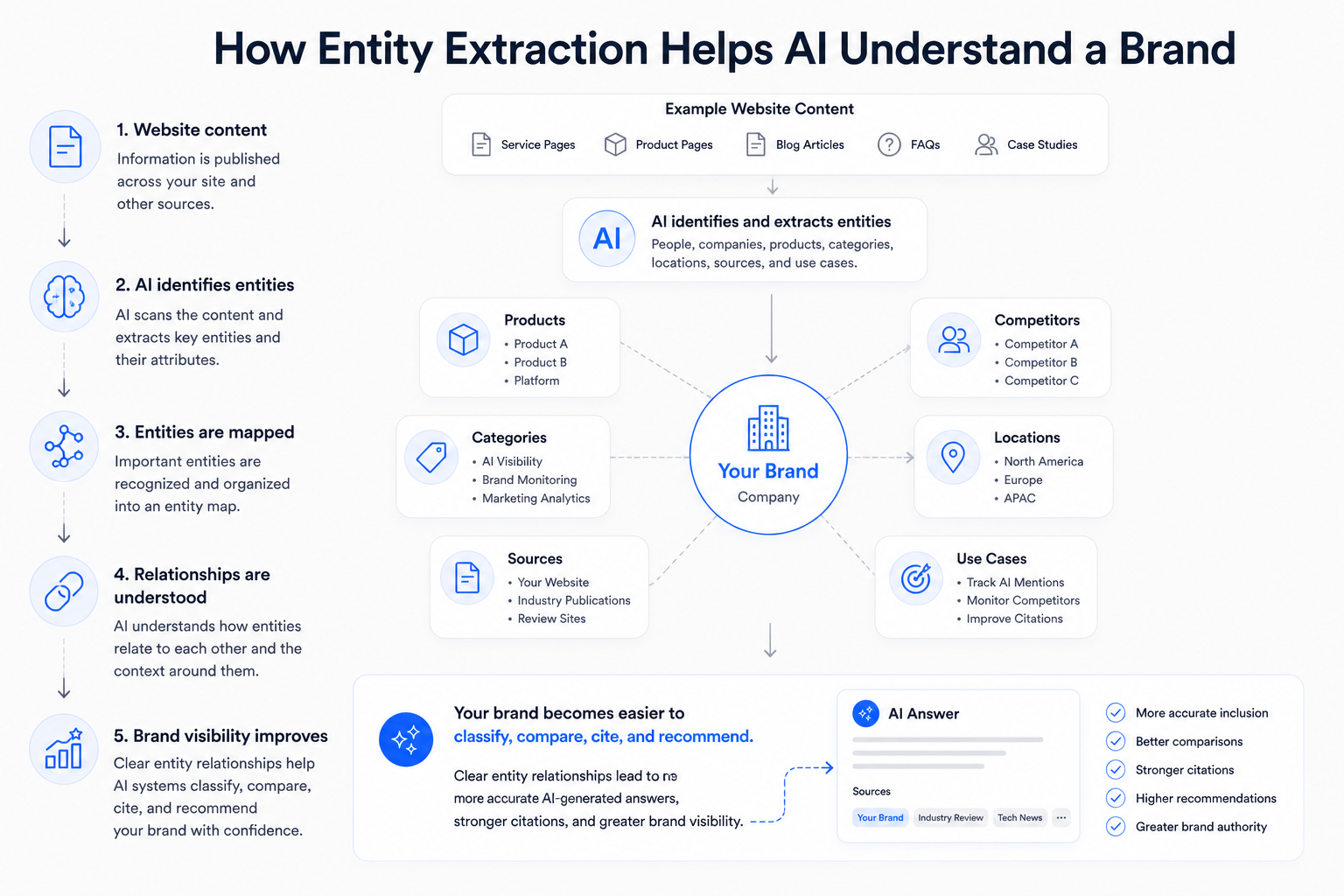
This is where entity extraction becomes important. Entity extraction is the process AI systems use to identify and understand people, companies, products, locations, and other meaningful concepts inside text.
Learn more about Entity Extraction →
AI Visibility Example
Imagine a company that sells project management software for construction teams.
A potential customer asks an AI system:
“What are the best project management tools for small construction companies?”
The AI-generated answer might include five brands. Some may be large general-purpose platforms. Some may be construction-specific. Some may be cited from review sites, software directories, blog posts, or vendor pages.
From an AI visibility perspective, the company would want to know:
- Was the brand mentioned?
- Was it recommended or only listed?
- Were competitors included instead?
- What sources shaped the answer?
- Was the brand described accurately?
- Did the answer mention the right audience and use case?
- Did the AI system cite the company’s own website or third-party sources?
- Did the answer change across different AI platforms?
This is different from asking, “Do we rank for this keyword?”
The better question is:
When buyers ask AI systems about our category, do we show up in the answer?
How Brands Can Improve AI Visibility
AI visibility is still an emerging discipline, but the core strategy is straightforward: make it easier for AI systems to understand, verify, and trust your brand’s relevance.
That starts with clear, structured content.
Define the brand clearly
Your website should make it easy to understand:
- what your company does
- who you serve
- which problems you solve
- which categories you belong to
- which products or services you offer
- how you are different from competitors
This information should be consistent across your homepage, product pages, about page, comparison pages, FAQs, schema, and external profiles.
Create content that answers real buyer questions
AI systems are often responding to natural-language prompts. Brands should create content around the questions customers actually ask during research and evaluation.
Examples include:
- “Best tools for…”
- “How to choose…”
- “What is…”
- “Alternatives to…”
- “Comparison of…”
- “How much does…”
- “What should I look for in…”
This does not mean publishing thin articles for every keyword variation. It means building a useful content system that reflects how people evaluate a category.
Strengthen category and use-case pages
A brand should not rely only on a homepage to explain its relevance. Specific pages for categories, use cases, industries, products, and customer types help AI systems understand where the brand fits.
Improve comparison and alternative content
AI-generated answers often compare options. If your site does not explain how you compare to other solutions, AI systems may rely entirely on third-party sources or competitor-owned narratives.
Support claims with evidence
Case studies, testimonials, customer examples, integrations, third-party mentions, awards, reviews, and data points all help reinforce credibility.
Keep content current
Outdated content can weaken AI visibility. If product names, service areas, positioning, pricing, or capabilities change, brands should update key pages and supporting sources.
Monitor AI answers over time
Because generated answers can change, AI visibility should not be treated as a one-time audit. Monitoring helps teams identify where they are gaining visibility, losing visibility, being misrepresented, or being replaced by competitors.
AI Visibility and Brand Strategy
AI visibility is not only a search problem. It is also a brand strategy problem.
AI-generated answers can influence how people understand a company before they ever speak with sales, visit a website, or read a case study. That means brands need to think carefully about the information ecosystem around them.
The key questions are:
- Is our positioning clear?
- Is our category association strong?
- Are we included in relevant AI answers?
- Are competitors being recommended more often?
- Are AI systems using accurate information?
- Are the right sources shaping the answer?
- Are we building the type of content AI systems can understand?
Strong AI visibility comes from the combination of clear brand positioning, useful content, consistent entity signals, credible sources, and ongoing monitoring.
Back to AI Fundamentals
See where your brand stands in AI results
AI-generated answers are already shaping how people discover companies, compare options, and decide who to trust. Toren helps brands monitor AI visibility, understand where competitors are being recommended, and identify the content opportunities that can improve inclusion.
FAQ
What does AI visibility mean?
AI visibility means how often, how accurately, and how favorably a brand appears in AI-generated answers. It includes brand mentions, recommendations, citations, competitor comparisons, and whether AI systems correctly understand what the brand does.
Is AI visibility the same as SEO?
No. SEO focuses on visibility in traditional search results. AI visibility focuses on whether a brand appears inside AI-generated answers from tools like ChatGPT, Gemini, Claude, Perplexity, and AI-powered search experiences.
Why does AI visibility matter for brands?
AI visibility matters because people increasingly use AI systems to research companies, compare products, and make decisions. If a brand is missing, misrepresented, or replaced by competitors in AI-generated answers, it can affect awareness, trust, and demand.
How can a brand improve AI visibility?
A brand can improve AI visibility by creating clear, structured content, strengthening category and use-case pages, improving comparison content, supporting claims with credible evidence, maintaining accurate brand information, and monitoring AI-generated answers over time.
Can AI visibility change over time?
Yes. AI visibility can change as models update, sources change, competitors publish new content, citations shift, and user prompts evolve. This is often called AI drift.