What Is AI Drift, and Why Does It Matter for Brand Visibility?
AI drift is the change in AI-generated answers over time.
For brands, AI drift matters because the way AI systems describe, recommend, cite, or omit a company can change from one answer to the next. A brand may appear in an AI-generated answer one month and disappear the next. A competitor may start being recommended more often. A citation may change. A product description may become outdated. A category summary may shift.
In traditional search, teams are used to monitoring rankings, traffic, and search visibility over time. AI-generated answers create a different kind of monitoring challenge.
The output is not always static.
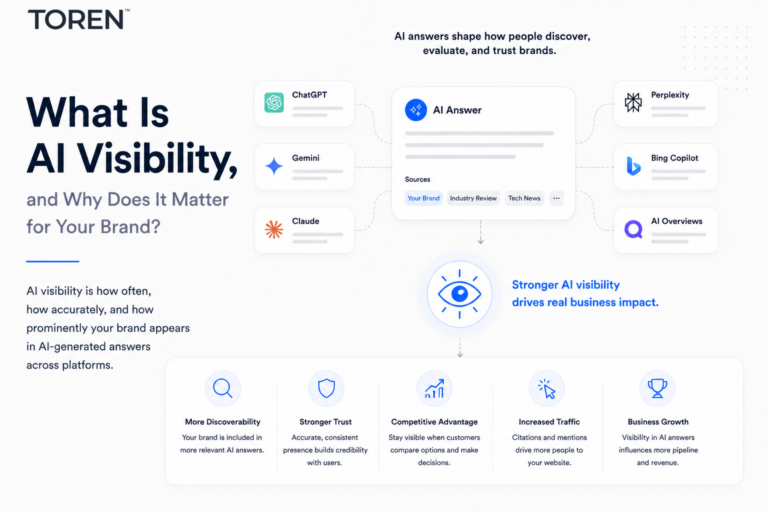
Tools like ChatGPT, Gemini, Claude, Perplexity, and AI-powered search experiences may generate different answers based on model updates, source changes, retrieval behavior, prompt wording, personalization, location, or new information entering the public web.
That means AI visibility is not something a brand can check once and forget.
AI drift is one reason ongoing visibility monitoring matters.

Why AI Drift Happens
AI-generated answers can change for several reasons.
Some changes come from the AI systems themselves. Models are updated, retrieval systems change, answer formatting evolves, and new product features are introduced.
Other changes come from the information environment around the brand. Competitors publish new content. Review sites update category pages. News articles appear. Product pages change. Third-party sources gain or lose relevance. Your own website may be updated.
Prompt behavior also matters. A small change in wording can lead to a different answer.
For example:
- “best AI visibility tools”
- “top AI visibility platforms for marketing teams”
- “AI visibility software for enterprise brands”
- “alternatives to [competitor]”
- “tools to monitor brand mentions in ChatGPT”
These prompts are related, but they may produce different brand lists, citations, recommendations, and explanations.
AI drift happens because generated answers are dynamic. They reflect a changing mix of model behavior, available sources, prompt interpretation, and category context.
AI Drift Is a Brand Visibility Problem
AI drift matters because it can change how buyers understand a brand.
A company may have strong visibility today but weaker visibility later. A competitor may gain inclusion. A brand may lose citations. A model may begin describing the company with outdated or incomplete language.
This creates a new kind of visibility risk.
In traditional SEO, a team may notice that a page drops from position three to position eight. In AI visibility, the shift may look different:
- the brand stops appearing in recommended lists
- the brand appears but is no longer described favorably
- a competitor is introduced as the stronger option
- citations shift away from the brand’s website
- the answer summarizes the category differently
- the brand is associated with the wrong use case
- the answer becomes less accurate over time
The brand may not know this is happening unless it is monitoring AI-generated answers.
Learn more about AI Visibility →
Common Types of AI Drift
AI drift can show up in several ways.
Mention drift
Mention drift happens when a brand’s presence in AI-generated answers changes over time.
A brand may be included in relevant answers during one run but omitted in a later run. It may appear less frequently, appear only for narrower prompts, or be replaced by competitors.
For many teams, mention drift is the first visible sign that AI visibility is changing.
Citation drift
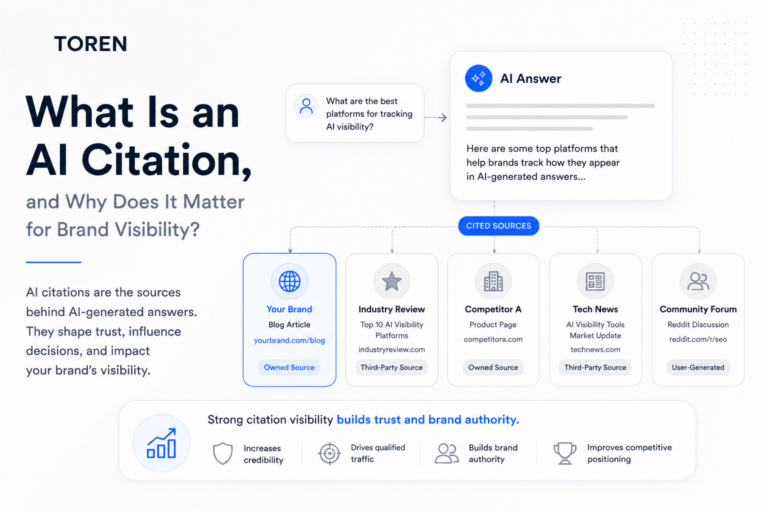
Citation drift happens when the sources used or surfaced by AI answer engines change.
One month, an AI system may cite a brand’s own website. Later, it may cite a review platform, a competitor page, a directory, a news article, or no visible citation at all.
Citation drift matters because citations can influence trust, traffic, and the source narrative behind the answer.
Learn more about AI Citations →
Recommendation drift
Recommendation drift happens when the brands recommended by an AI system change.
A company may be listed as a top option in one answer and only mentioned in passing later. A competitor may move from a secondary mention to the primary recommendation.
This is especially important for prompts like:
- “best tools for…”
- “top companies for…”
- “which provider should I choose…”
- “best alternatives to…”
- “recommended platforms for…”
These are high-intent discovery moments.
Positioning drift
Positioning drift happens when an AI system changes how it describes a brand.
A company may be described as enterprise-focused in one answer and small-business-focused in another. A product may be framed as a reporting tool instead of a strategy platform. A local business may be described as regional or national depending on the source context.
Positioning drift can change whether a brand feels relevant to a buyer.
Competitor drift
Competitor drift happens when the competitive set around a brand changes in AI-generated answers.
The AI system may begin including new competitors, remove older competitors, or compare the brand to companies that do not actually belong in the same category.
This can reveal how AI systems are interpreting the market.
Accuracy drift
Accuracy drift happens when answer quality changes over time.
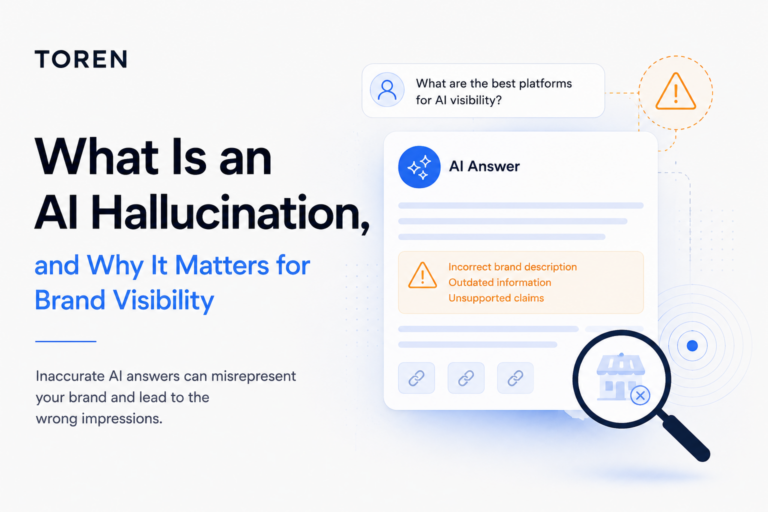
An AI system may describe a brand correctly during one run but later introduce outdated details, unsupported claims, missing products, incorrect locations, or confusing comparisons.
Accuracy drift is closely related to AI hallucinations.
Learn more about AI hallucinations →
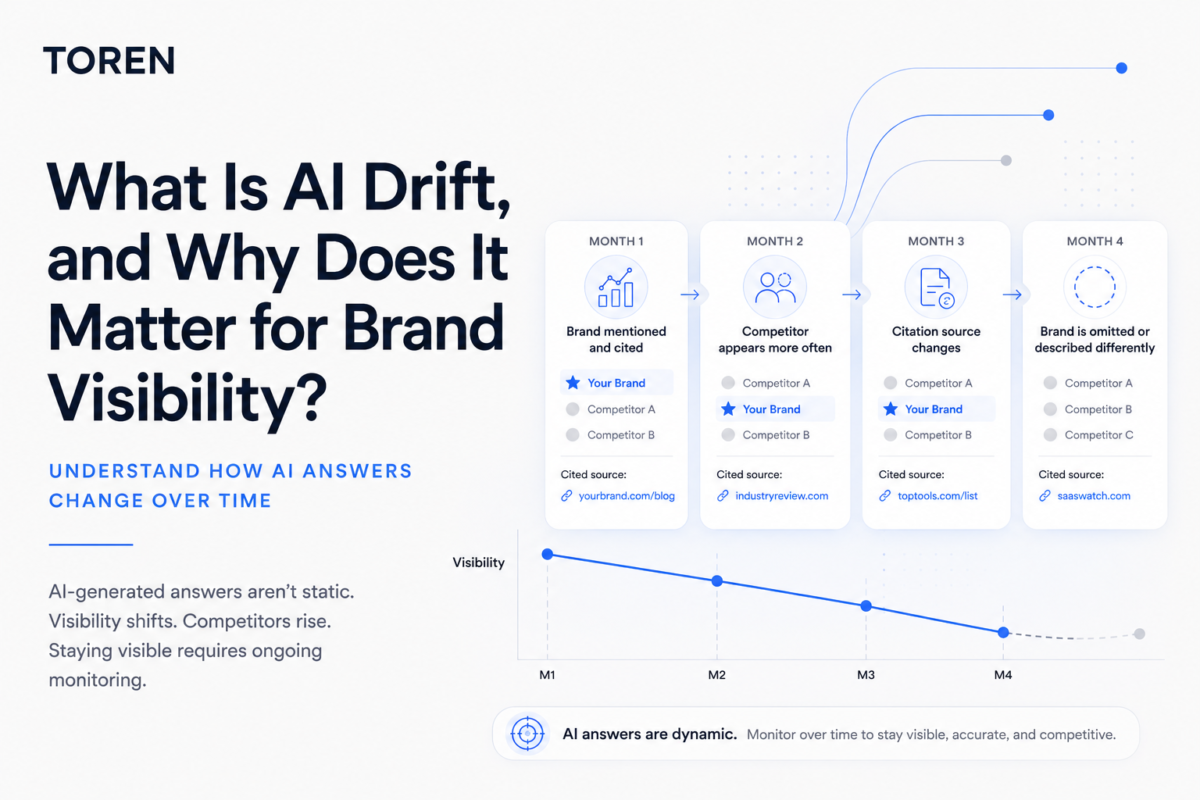
Example: How AI Drift Can Affect a Brand
Imagine a company that provides AI visibility tracking for marketing teams.
In January, a user asks:
“What are the best platforms for monitoring how my brand appears in AI-generated answers?”
The AI-generated answer includes the company, describes it accurately, and cites the company’s Learning Center article about AI visibility.
In February, the same prompt produces a different answer. The company still appears, but a competitor is now recommended first. The citation points to a third-party list instead of the company’s website.
In March, the company is missing from the answer entirely. The AI system recommends three competitors and describes the category using language those competitors have been publishing heavily.
Nothing obvious may have happened inside the company’s website analytics. But from an AI visibility perspective, something changed.
That is AI drift.
Why One-Time AI Audits Are Not Enough
A one-time AI visibility audit can be useful. It can show where a brand appears, where competitors are being recommended, and where the answer seems inaccurate at a specific moment.
But it cannot show movement.
AI-generated answers change over time. A snapshot does not reveal whether visibility is improving, declining, or becoming less accurate.
A one-time audit may miss:
- emerging competitors
- citation changes
- new source influence
- declining brand mentions
- changing answer language
- hallucination risk
- prompt-level volatility
- model-specific differences
This is why AI drift should be measured over time.
The strategic question is not only:
How does AI describe our brand today?
It is also:
How is that changing?
What Causes Brand Visibility to Drift?
Brand visibility can drift because of internal and external changes.
Your own content changes
When a brand updates its website, publishes new content, changes messaging, or removes old pages, AI systems may interpret the brand differently.
Positive changes can improve visibility. Poorly structured changes can create confusion.
Competitors publish new content
AI visibility is competitive. If competitors publish stronger comparison pages, clearer category content, better FAQs, or more useful educational resources, they may begin appearing more often in generated answers.
Third-party sources change
Review platforms, directories, news articles, listicles, social discussions, and partner pages can influence how AI systems describe a category.
If these sources change, AI-generated answers may change too.
Models and retrieval systems update
AI platforms are constantly evolving. Model behavior, retrieval logic, citation systems, source selection, and answer formatting can change.
This can affect visibility even if your own website has not changed.
Prompt language evolves
Customers may change how they ask questions. New terms may emerge. Category language may shift. Acronyms may become more common. Buyers may ask more specific use-case questions as they become more educated.
Brands need to monitor the prompts that matter, not only the keywords they historically targeted.
How Brands Can Monitor AI Drift
Monitoring AI drift starts with a clear prompt set.
A brand should identify the questions that matter most to discovery, evaluation, and comparison.
These may include:
- category prompts
- competitor prompts
- alternative prompts
- local prompts
- use-case prompts
- product prompts
- pricing prompts
- problem-aware prompts
- brand-specific prompts
For each prompt, teams should monitor how AI systems respond over time.
Important signals include:
- whether the brand appears
- where it appears in the answer
- which competitors appear
- whether the brand is recommended
- which sources are cited
- how the brand is described
- whether the answer is accurate
- whether the answer changes by platform
- whether the answer changes over time
The goal is not to obsess over every single answer variation. The goal is to identify meaningful patterns.
How Brands Can Respond to AI Drift
When AI drift appears, the right response depends on the pattern.
If brand mentions decline
Review whether your category, use-case, and comparison content is clear enough. Look at whether competitors have stronger content or more third-party coverage.
If citations shift away from your site
Check whether your content is still current, useful, and directly relevant to the prompts being asked. Strengthen pages that answer the question more clearly.
If competitors gain visibility
Analyze what they are publishing, which sources mention them, and how AI systems describe their strengths. This can reveal content gaps or positioning weaknesses.
If the brand is described inaccurately
Update core pages, improve FAQs, strengthen entity clarity, add structured data, and correct outdated external profiles where possible.
If visibility varies by platform
Compare differences across AI systems. Some may rely more heavily on web retrieval, citations, or recent sources, while others may respond from broader model knowledge.
AI Drift and Content Strategy
AI drift is one reason content strategy needs to become more structured.
If a brand publishes disconnected articles without a clear information architecture, AI systems may struggle to understand the brand’s category, products, use cases, and differentiators.
A stronger approach is to build a connected content system.
That includes:
- definition pages
- category pages
- use-case pages
- comparison pages
- FAQ pages
- methodology pages
- product pages
- customer proof
- authoritative third-party sources
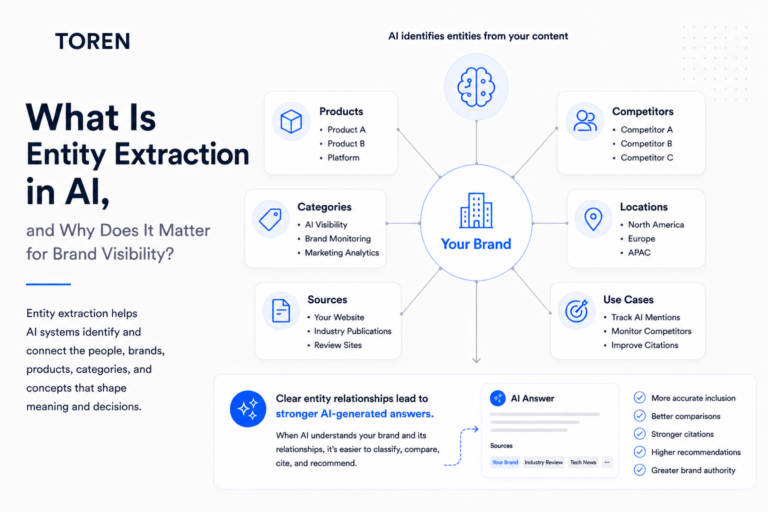
Each page should reinforce the brand’s relationship to important entities, categories, problems, and buyer questions.
This does not mean publishing more content for the sake of volume. It means creating a clearer information ecosystem around the brand.
Learn more about Generative Engine Optimization →
AI Drift Is Not Always Bad
Not all drift is negative.
AI drift can also reveal improvement.
A brand may begin appearing more often after publishing stronger content. Citations may shift toward better sources. AI systems may start describing the brand more accurately. A company may move from being mentioned occasionally to being recommended consistently.
The key is knowing the difference between random variation and meaningful change.
That requires consistent measurement.
Final Takeaway
AI drift is the movement of AI-generated answers over time.
For brands, that movement can affect visibility, citations, recommendations, accuracy, and competitive positioning.
As AI systems become more important in discovery and decision-making, brands need to understand not only whether they appear in AI answers, but how that appearance changes.
AI visibility is not static.
The brands that monitor drift will be better positioned to identify risks, respond to competitor movement, improve content strategy, and protect how they are represented in AI-generated answers.
Related Reading
- What is AI Visibility?
- What is Generative Engine Optimization?
- What is an AI Citation?
- What is an AI Hallucination?
Back to AI Fundamentals
Track how AI visibility changes over time
Toren helps brands monitor AI-generated answers, identify visibility changes, understand competitor movement, and find the content opportunities that can improve brand inclusion.