What Is an AI Hallucination, and Why Does It Matter for Brand Visibility?
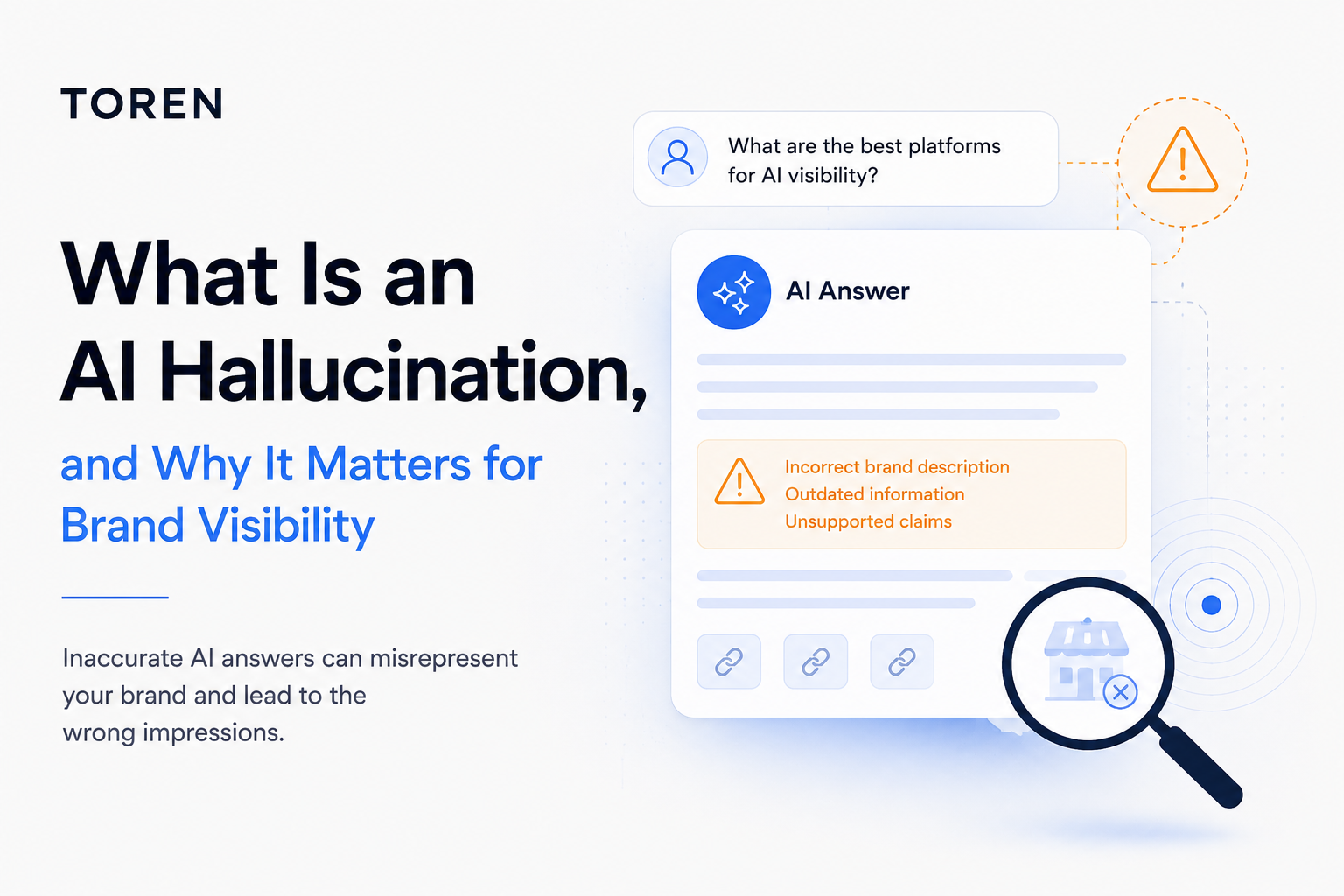
An AI hallucination is an inaccurate, unsupported, or misleading answer generated by an AI system that may sound confident even when it is wrong.
In the context of brand visibility, hallucinations matter because AI systems may describe a company incorrectly, recommend the wrong competitors, cite irrelevant sources, invent product details, confuse one brand with another, or summarize a category in ways that distort how a business is understood.
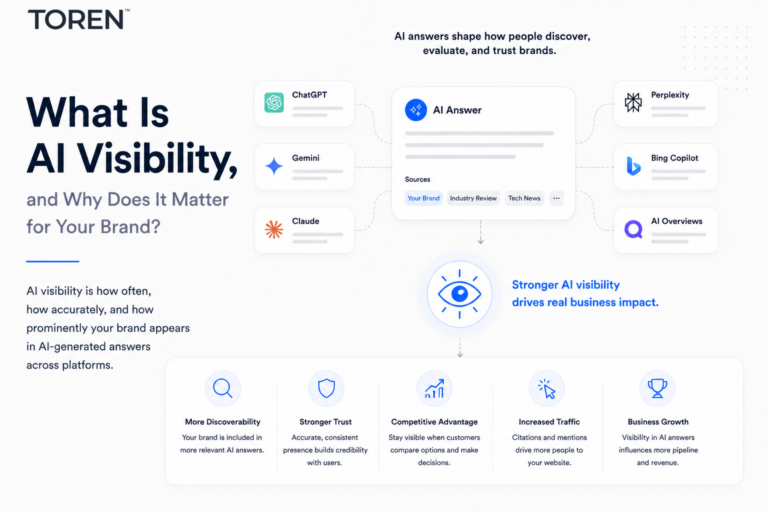
This is one of the reasons AI visibility is not only about whether a brand appears in AI-generated answers. It is also about whether the brand appears accurately.
A brand can be mentioned and still be misrepresented.
A company can be included in an answer and still lose trust if the answer describes outdated services, incorrect locations, unsupported claims, or the wrong product category.
As more people use tools like ChatGPT, Gemini, Claude, Perplexity, and AI-powered search experiences to research companies and compare options, hallucinations become a real brand risk.

Why AI Hallucinations Happen
AI systems generate answers by predicting and synthesizing information based on patterns, context, training data, retrieved sources, and user prompts. They do not understand truth in the same way a human expert does.
Depending on the system and the prompt, an AI answer may be influenced by incomplete information, outdated sources, unclear entities, weak context, or conflicting signals.
Hallucinations can happen when:
- the model lacks reliable information
- the prompt is vague or overly broad
- multiple brands or products have similar names
- source material is outdated or inconsistent
- the model fills in gaps instead of saying it does not know
- the answer combines true details with unsupported assumptions
- retrieved sources do not clearly support the response
For brands, this means public information quality matters. If the information ecosystem around a company is thin, inconsistent, or confusing, AI systems may have a harder time representing the brand correctly.
AI Hallucinations Are a Brand Visibility Problem
Many people think of hallucinations as a general AI accuracy issue. That is true, but for companies, hallucinations are also a brand visibility issue.
AI-generated answers can shape what people believe about a business before they visit its website, speak with sales, read a case study, or contact the company directly.
A hallucinated answer may cause a user to believe:
- a brand offers a product it does not offer
- a brand does not serve a market it actually serves
- a competitor is a better fit based on false assumptions
- a company is located somewhere it is not
- a product has limitations that are no longer true
- a service is unavailable, discontinued, or not relevant
- a brand belongs to the wrong category
In these cases, the problem is not simply visibility. The problem is inaccurate visibility.
Learn more about AI visibility →
Common Types of AI Hallucinations for Brands
AI hallucinations can show up in several ways during brand discovery and evaluation.
Incorrect brand descriptions
An AI system may describe a company using outdated, overly broad, or incorrect language.
For example, a specialized B2B software company may be described as a general marketing agency. A local service provider may be described as operating nationally. A product-led company may be described as a consulting firm.
These errors can affect how buyers understand the brand.
Invented product or service details
AI systems may sometimes invent features, pricing details, integrations, certifications, service areas, or product capabilities.
This is especially risky when users are comparing vendors. A hallucinated feature can make one brand look stronger or weaker than it actually is.
Competitor confusion
AI systems may confuse similar companies, especially when names, categories, or descriptions overlap.
A brand may be compared to the wrong competitors or excluded from the right competitive set.
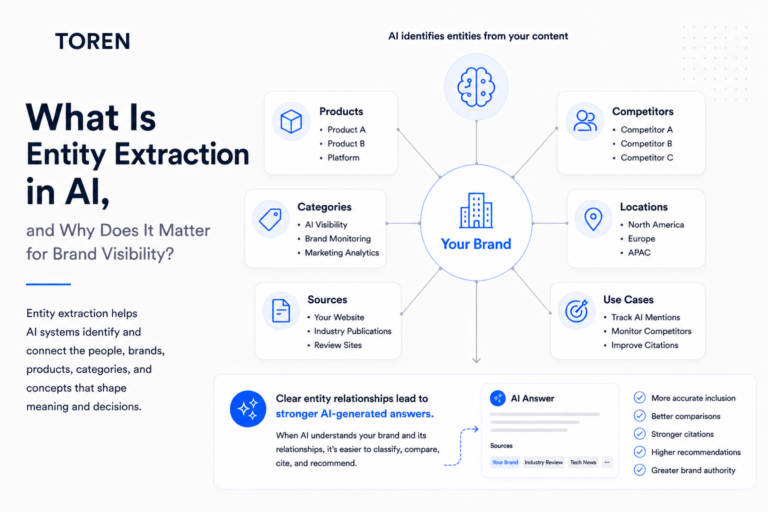
This is where entity clarity matters. AI systems need clear signals that distinguish one brand, product, location, and category from another.
Learn more about Entity Extraction →
Unsupported recommendations
An AI system may recommend a brand for a use case that is not well supported by available evidence.
It may also recommend a competitor based on incomplete or outdated information.
In both cases, the generated answer can influence demand even if the reasoning is weak.
Wrong or missing citations
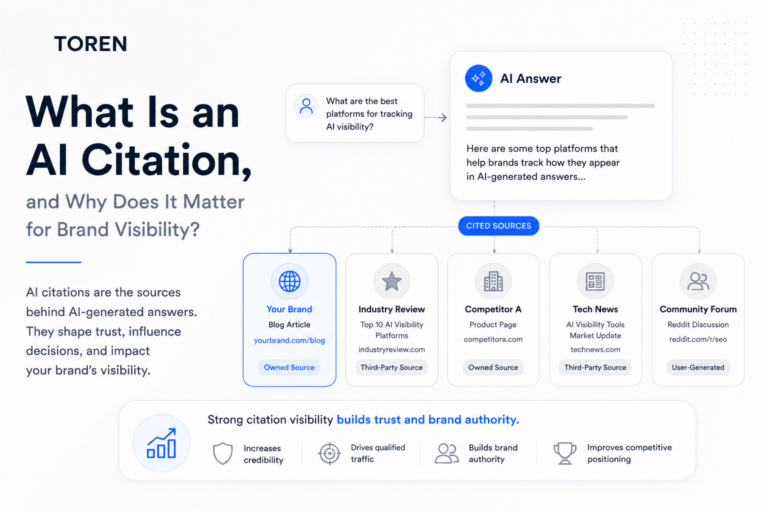
Some AI answer engines provide citations. Those citations may be helpful, but they are not automatically perfect.
A citation may support only part of an answer, point to outdated information, reference a weak source, or fail to support the claim being made.
Learn more about AI citations →
Outdated information
A model may summarize a brand based on old positioning, old product pages, legacy names, discontinued services, outdated reviews, or stale third-party listings.
This can be especially damaging for companies that have recently repositioned, launched new products, changed markets, or updated their offer.
Example: How a Hallucination Can Affect a Brand
Imagine a company that provides AI visibility tracking for enterprise marketing teams.
A potential buyer asks:
“What are the best platforms for tracking how my company appears in AI-generated answers?”
The AI-generated answer includes the brand but describes it as a general SEO reporting tool. It also says the company focuses mainly on keyword rankings and backlinks, even though the product is designed specifically for AI visibility, brand mentions, citations, and competitor inclusion across AI answer engines.
The brand appears in the answer, but the answer is wrong.
From the user’s perspective, the company may seem less relevant than competitors that are described more accurately.
From the brand’s perspective, this is a visibility problem, a positioning problem, and a trust problem.
The brand did not simply need to “show up.” It needed to be understood correctly.
Hallucinations Can Be Confident and Hard to Notice
One of the challenges with AI hallucinations is that they can sound polished.
An answer may be written clearly, structured well, and presented with confidence. That can make inaccurate information feel credible.
This is especially important in business categories where users are not experts. If someone is researching a new solution, they may not know which details are wrong.
A hallucinated answer can quietly shape perception.
That is why companies should not assume that AI-generated mentions are always beneficial. Visibility without accuracy can create risk.
How Brands Can Reduce Hallucination Risk
Brands cannot fully prevent AI hallucinations. No company controls every model, data source, retrieval system, or generated response.
But brands can reduce the risk of being misrepresented by improving the clarity, consistency, and credibility of the information available about them.
Make positioning clear
Your website should clearly explain what your company does, who it serves, and which category it belongs to.
Avoid vague language that could apply to almost any company.
Specificity helps AI systems understand context.
Keep core pages current
Update important pages when your products, services, pricing, positioning, locations, or target markets change.
Key pages include:
- homepage
- product pages
- service pages
- about page
- FAQ pages
- comparison pages
- pricing pages
- customer story pages
- documentation or methodology pages
Build strong entity signals
Use consistent brand names, product names, category language, and descriptions across your website and external profiles.
If a company, product, or location has multiple names, make those relationships clear.
Add direct answers to important questions
AI systems often respond to natural-language prompts. Your content should answer the questions buyers are likely to ask.
Examples:
- What does the company do?
- Who is the product for?
- What category does it belong to?
- What problems does it solve?
- How is it different from alternatives?
- Which use cases is it best suited for?
- What does it not do?
Support claims with evidence
Credible proof points reduce ambiguity.
Useful evidence includes:
- case studies
- customer examples
- testimonials
- reviews
- third-party mentions
- integrations
- certifications
- awards
- methodology pages
- original research
Use structured data where appropriate
Schema can help define important page information in a machine-readable way.
For educational articles, Article schema, FAQPage schema, BreadcrumbList schema, and DefinedTerm schema can help reinforce the purpose and topic of the page.
Schema is not a guarantee against hallucinations, but it supports clarity.
Monitor AI answers over time
Because AI-generated answers can change, brands should monitor important prompts regularly.
Monitoring helps identify whether a brand is being omitted, misrepresented, confused with competitors, cited incorrectly, or described with outdated information.
Hallucinations and AI Drift
AI hallucinations are often connected to AI drift.
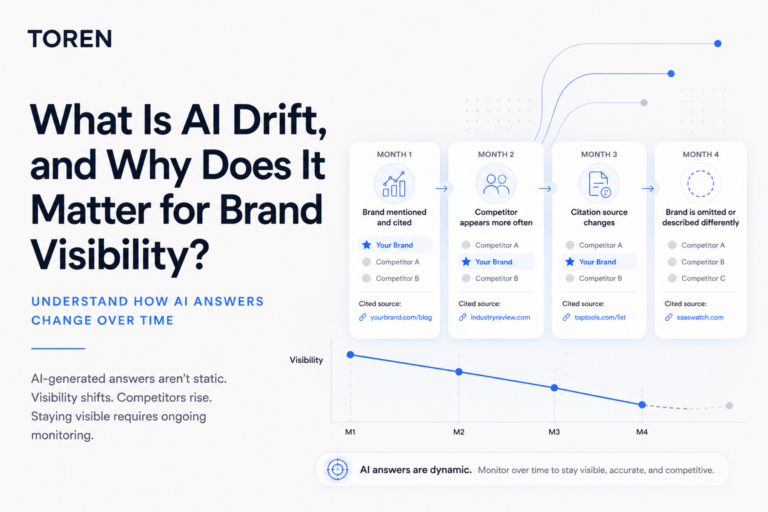
A brand may be described accurately in one answer and inaccurately in another. A citation may appear one month and disappear the next. A competitor may start appearing more often because its content or third-party coverage has changed.
AI-generated answers are dynamic.
That means hallucination risk is not something brands can check once and ignore.
Learn more about AI drift →
What To Do If AI Misrepresents Your Brand
If an AI system describes your brand incorrectly, the first step is to identify the likely source of confusion.
Ask:
- Is the brand’s own website clear?
- Are product and service pages up to date?
- Are third-party listings accurate?
- Are review sites using old descriptions?
- Are competitors using similar language?
- Is there another brand with a similar name?
- Are citations pointing to outdated or irrelevant pages?
- Does the answer vary across AI platforms?
Then prioritize the fixes that are most likely to improve clarity.
This may include updating core pages, improving FAQs, creating comparison content, strengthening category pages, correcting external profiles, adding schema, publishing clearer methodology content, or earning better third-party mentions.
The goal is not to chase every incorrect answer manually.
The goal is to improve the information ecosystem that AI systems rely on.
AI Hallucinations and Trust
Trust is central to AI visibility.
A brand wants to be visible, but it also wants to be represented accurately. If AI-generated answers consistently describe a company in the wrong way, the brand may lose trust before the buyer ever reaches the website.
This is especially important for high-consideration categories where buyers compare multiple options, evaluate risk, and rely on expert guidance.
AI hallucinations can affect:
- brand perception
- competitive positioning
- product understanding
- lead quality
- sales conversations
- customer expectations
- reputation
- trust
For this reason, hallucination monitoring should be part of AI visibility strategy.
Related Reading
Back to AI Fundamentals
Know when AI gets your brand wrong
Toren helps brands monitor how they appear in AI-generated answers, identify inaccurate or outdated brand descriptions, and understand where competitors are being recommended instead.