What Is Entity Extraction in AI, and Why Does It Matter for Brand Visibility?
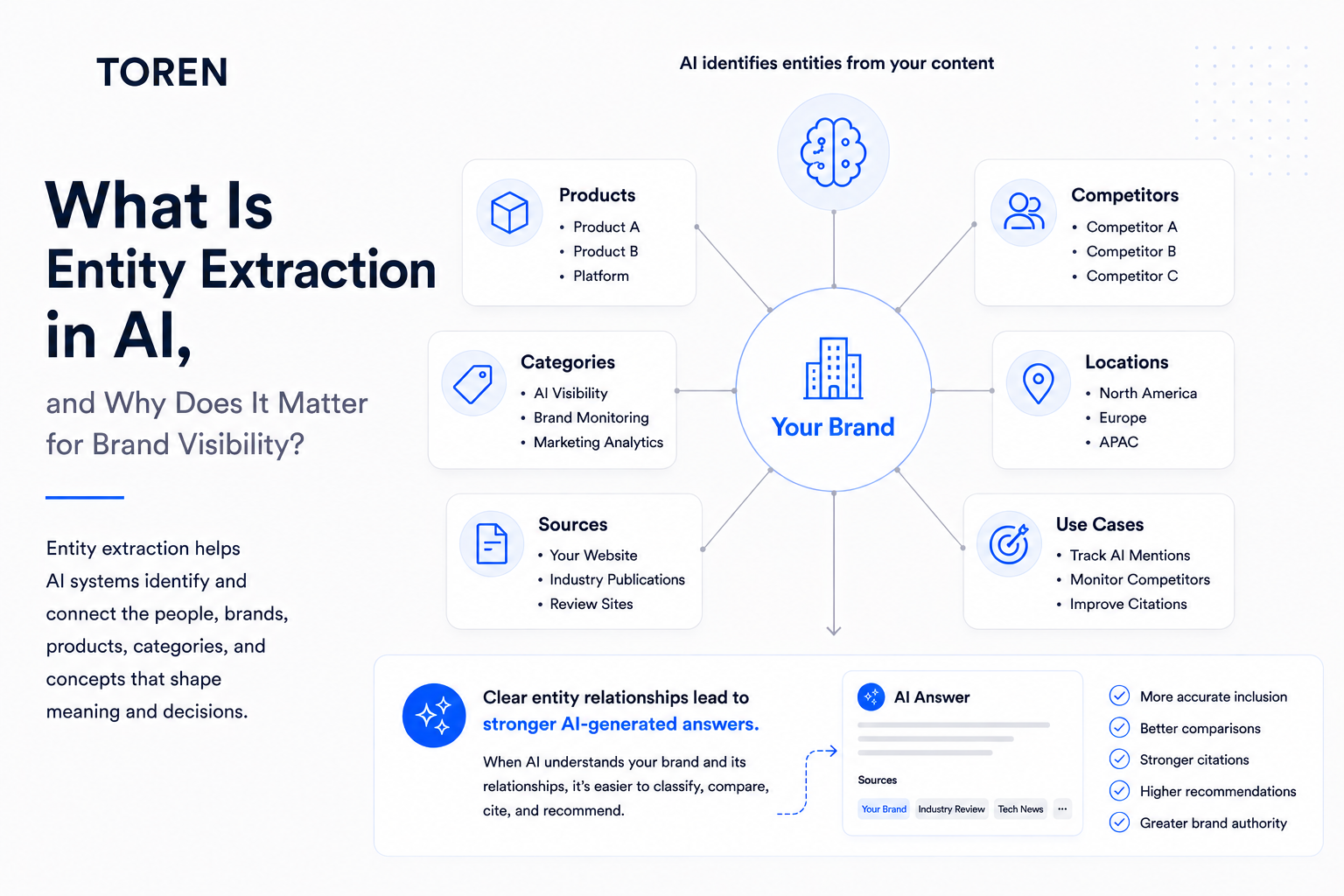
Entity extraction is the process AI systems use to identify important people, companies, products, locations, categories, and concepts inside text.
In simple terms, entity extraction helps AI systems understand what a piece of content is talking about.
For brands, this matters because AI-generated answers depend on more than keywords. AI systems need to understand that a company is a distinct brand, that its products belong to specific categories, that competitors are separate entities, and that certain locations, services, industries, or use cases are connected to the brand.
If those relationships are unclear, a brand may be omitted, miscategorized, confused with competitors, or described inaccurately in AI-generated answers.
Entity extraction is one of the underlying reasons brand clarity matters in AI visibility.
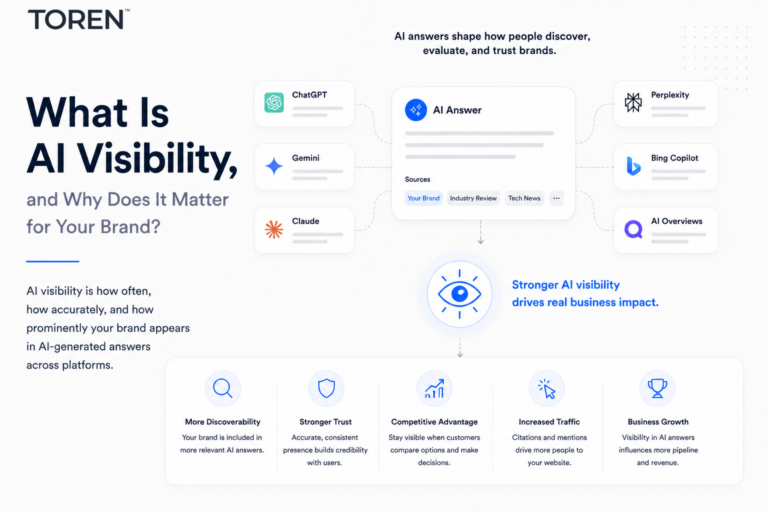
When tools like ChatGPT, Gemini, Claude, Perplexity, and AI-powered search experiences generate answers, they are often interpreting relationships between entities: companies, products, categories, sources, competitors, and user intent.
The clearer those relationships are, the easier it becomes for AI systems to understand where a brand fits.

Why Entity Extraction Matters
AI systems do not evaluate content only by scanning for individual keywords. They also interpret meaning, context, and relationships.
That means a brand’s visibility depends partly on whether AI systems can answer questions like:
- What is this company?
- What category does it belong to?
- What products or services does it offer?
- Who does it serve?
- Which competitors are related?
- What locations or markets are relevant?
- What sources describe or support the brand?
- What use cases is the brand associated with?
If the answers are clear, the brand is easier to include in relevant AI-generated answers.
If the answers are unclear, the AI system may rely on incomplete information, competitor content, third-party summaries, or assumptions.
This can affect whether the brand appears, how it is described, and which sources are cited.
Learn more about AI visibility →
Entity Extraction Is Different from Keyword Matching
Traditional search strategy often focused heavily on keywords.
Keywords still matter, but AI systems increasingly work with broader meaning and context.
A keyword is a word or phrase.
An entity is a specific thing.
For example:
- “AI visibility” can be a topic or category
- “Toren” can be a brand entity
- “ChatGPT” can be a product/entity
- “Cisco” can be an organization entity
- “New York” can be a location entity
- “Generative Engine Optimization” can be a concept entity
- “brand monitoring” can be a use-case or category concept
Entity extraction helps AI systems identify these things and understand how they relate.
A page that repeats a keyword many times may still be less useful than a page that clearly explains the brand, category, product, audience, and source relationships.
This is one reason modern AI visibility strategy should be built around structured meaning, not only search terms.
Common Types of Entities AI Systems May Identify
Entity extraction can apply to many different types of information.
For brand visibility, the most important entities often include the following.
Brand entities
A brand entity is the company or organization itself.
For example, an AI system should understand that Toren is a brand, not just a word on a page.
Strong brand entity signals include consistent naming, clear descriptions, accurate homepage copy, organization schema, external profiles, and third-party mentions.
Product entities
Products or services can also become entities.
If a company offers multiple products, platforms, dashboards, modules, reports, or services, those should be clearly named and explained.
This helps AI systems understand what the brand actually provides.
Category entities
Category entities define the market or problem space the brand belongs to.
Examples include:
- AI visibility tracking
- generative engine optimization
- AI search monitoring
- brand visibility reporting
- local SEO
- marketing analytics
- customer data platforms
- project management software
Category clarity is essential for AI-generated recommendation prompts.
Competitor entities
AI systems often compare brands. That means competitor relationships matter.
If competitors are well-defined in the information ecosystem and your brand is not, AI systems may include competitors more often or frame the category around them.
Location entities
For local, regional, or multi-location businesses, location entities are important.
AI systems may need to understand cities, states, counties, service areas, office locations, regions, or markets.
Location clarity can affect whether a brand appears for local or geography-specific prompts.
Source entities
Sources are also part of the visibility ecosystem.
A brand’s own website, third-party directories, review platforms, news articles, partner pages, and customer stories can all influence how AI systems understand the brand.
Use-case entities
Use cases help connect the brand to real buyer intent.
Examples include:
- tracking AI brand mentions
- monitoring competitor visibility
- improving AI citation presence
- reducing hallucination risk
- comparing vendors
- improving local discovery
- measuring content gaps
Use-case clarity helps AI systems understand when the brand is relevant.
Example: Entity Extraction in Brand Visibility
Imagine a company that provides AI visibility tracking for marketing teams.
A strong content ecosystem would help AI systems identify entities like:
- Brand: Toren
- Category: AI visibility tracking
- Related strategy: Generative Engine Optimization
- Use case: monitoring brand mentions in AI-generated answers
- Use case: tracking competitor inclusion
- Signal: AI citations
- Risk: AI hallucinations
- Trend: AI drift
- Audience: marketing teams, brand teams, agencies, enterprise companies
- Sources: Learning Center articles, product pages, FAQs, case studies, third-party mentions
When these entities are clearly connected, an AI system has a better chance of understanding what the brand does and when it should be included.
If those relationships are unclear, the system may describe the company as a generic SEO tool, omit it from relevant answers, or compare it to the wrong competitors.
That is why entity extraction matters for AI visibility.
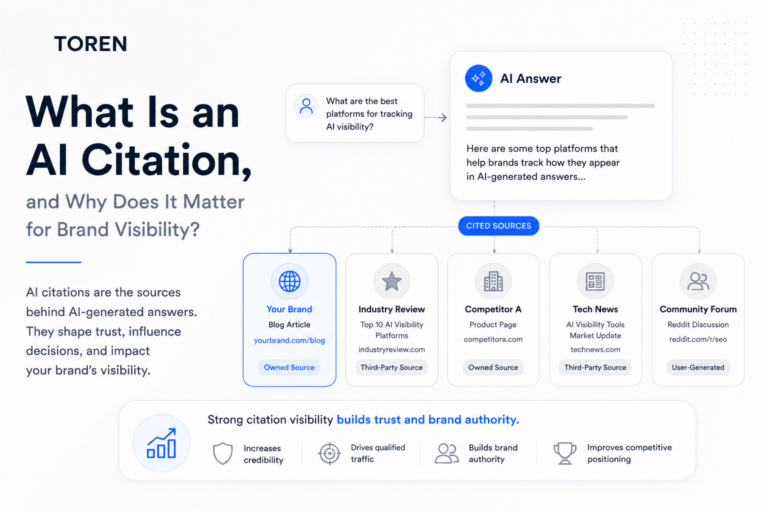
Entity Extraction and AI Citations
Entity extraction also affects citations.
When an AI system cites a source, it may be using that source to support information about a specific entity.
For example, an answer about AI visibility might cite a Learning Center page because that page clearly defines the concept. An answer about a company might cite a product page because it clearly describes the brand’s offer.
If a page does not clearly identify the relevant entities, it may be less useful as a source.
This is one reason brands should create pages with clear headings, direct definitions, structured sections, and consistent terminology.
Learn more about AI citations →
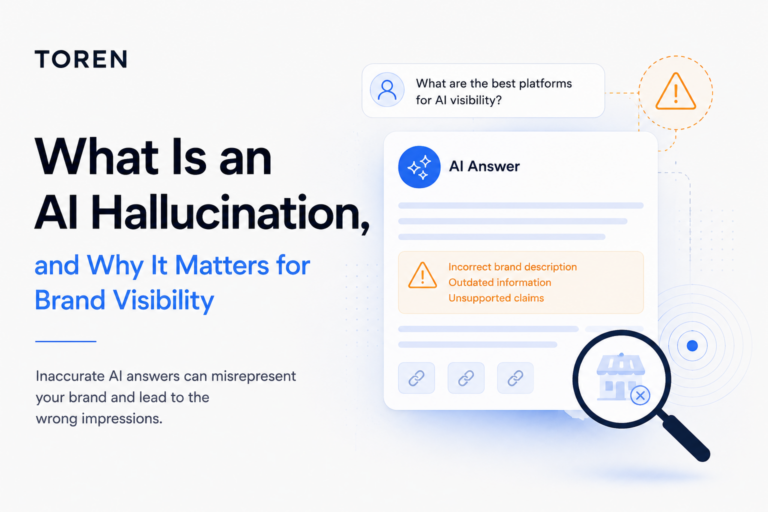
Entity Confusion and AI Hallucinations
Entity confusion can contribute to AI hallucinations.
If an AI system cannot clearly distinguish one brand from another, it may combine details from multiple companies, assign the wrong product to the wrong brand, or describe a company using inaccurate information.
This can happen when:
- brands have similar names
- products have overlapping names
- categories are vague
- external profiles are outdated
- company descriptions are inconsistent
- multiple locations or service areas are unclear
- old content conflicts with current positioning
For brands, this can lead to inaccurate AI-generated answers.
A company may appear in an answer, but the answer may describe the wrong services, wrong market, wrong product, or wrong customer type.
Learn more about AI hallucinations →
How Brands Can Improve Entity Clarity
Entity clarity comes from consistency, structure, and useful content.
The goal is to make the brand easier to understand across both owned and external sources.
Use consistent brand and product names
Use the same brand name, product names, service names, and category language across key pages.
If your brand or product has abbreviations, alternate names, or legacy names, explain those relationships clearly.
Clearly define the brand
Your homepage, about page, and product pages should directly answer:
- What does the company do?
- Who does it serve?
- What category does it belong to?
- What problems does it solve?
- What products or services does it provide?
- How is it different?
Avoid language that sounds polished but could apply to any company.
Build strong category pages
Category pages help AI systems connect the brand to the right market.
For example, if a company wants to be understood as an AI visibility platform, it should clearly explain AI visibility, why it matters, and how the product fits into that category.
Create use-case pages
Use-case pages connect the brand to specific buyer needs.
Examples include:
- monitoring AI brand mentions
- tracking competitor recommendations
- identifying AI citation gaps
- measuring AI drift
- improving brand accuracy in AI answers
- reporting AI visibility to leadership
Add structured internal links
Internal links help reinforce relationships between concepts.
For example, a page about entity extraction can link to AI visibility, AI citations, AI hallucinations, AI drift, and Generative Engine Optimization.
This helps create a connected knowledge graph across the site.
Learn more about Generative Engine Optimization →
Keep external profiles accurate
AI systems may interpret external information from third-party profiles, directories, review sites, partner pages, or news mentions.
If these sources use outdated descriptions, they may weaken entity clarity.
Use schema markup
Schema can help define important entities in a machine-readable format.
Useful schema types may include:
- Organization
- WebSite
- WebPage
- Article
- FAQPage
- BreadcrumbList
- Product
- Service
- LocalBusiness
- DefinedTerm
Schema is not a magic fix, but it supports clarity.
Create source-worthy content
Strong content helps AI systems understand concepts and relationships.
Educational articles, FAQs, methodology pages, comparison pages, product pages, and customer stories can all reinforce entity clarity when they are specific and well structured.
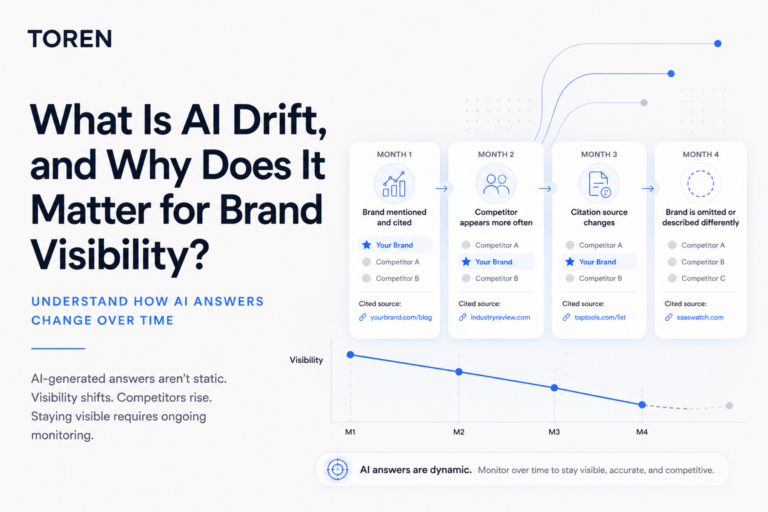
Entity Extraction and AI Drift
Entity relationships can change over time.
A brand may launch a new product, enter a new category, shift positioning, add locations, update services, or compete with different companies.
When public information changes, AI-generated answers may shift too.
This can lead to AI drift.
Monitoring drift helps brands see whether AI systems are keeping up with the current version of the company.
Learn more about AI drift →
What To Monitor for Entity Clarity
Brands should periodically review how AI systems identify and describe them.
Useful questions include:
- Does the AI system recognize the brand correctly?
- Does it place the brand in the right category?
- Does it mention the right products or services?
- Does it connect the brand to the right use cases?
- Does it identify relevant competitors correctly?
- Does it cite accurate sources?
- Does it confuse the brand with another company?
- Does it use outdated descriptions?
- Does the answer change across platforms?
- Does the answer change over time?
These questions help reveal whether entity extraction is working in the brand’s favor.
Entity Extraction and Content Strategy
Entity extraction reinforces a broader content strategy principle:
AI systems need clarity.
They need clear explanations, consistent naming, structured pages, useful relationships, credible sources, and updated information.
That means brands should not think only in terms of individual articles or keywords. They should think in terms of connected concepts.
A strong AI visibility content system helps AI understand:
- who the brand is
- what it offers
- which category it belongs to
- who it serves
- which use cases it supports
- which sources validate it
- how it compares to competitors
- why it should be included in AI-generated answers
This is the strategic foundation of generative engine optimization.
Final Takeaway
Entity extraction is the process AI systems use to identify important people, companies, products, locations, categories, sources, and concepts inside text.
For brands, entity extraction matters because AI-generated answers depend on whether systems can understand what the brand is, where it fits, and how it relates to other entities.
Clear entity signals can help a brand be classified correctly, cited more accurately, compared to the right competitors, and included in more relevant AI-generated answers.
Weak entity signals can lead to omission, confusion, hallucinations, and poor AI visibility.
Entity clarity is not just a technical concern.
It is a brand visibility strategy.
Related Reading
- What is AI Visibility?
- What is Generative Engine Optimization?
- What is an AI Citation?
- What is an AI Hallucination?
- What is AI Drift?
Back to AI Fundamentals
Help AI systems understand your brand clearly
Toren helps brands monitor AI-generated answers, identify where they are being included or misrepresented, and find content opportunities that improve brand clarity across AI answer engines.