Your Organic Traffic May Be Telling the Truth, But Not the Whole Story
For years, a decline in organic traffic usually triggered a familiar investigation.
Did rankings fall?
Did a technical issue get introduced?
Did a competitor publish better content?
Did Google roll out an algorithm update?
Did the site lose authority, links, speed, structure, or relevance?
Those questions still matter. They are still worth asking. In many cases, they still explain what happened.
But increasingly, they may not explain all of it.
Something larger is happening around search. Not the death of Google. Not the end of SEO. Not some clean before-and-after moment where one channel disappears and another replaces it.
It is more subtle than that, and probably more important.
Consumer behavior is changing faster than most analytics dashboards were built to explain.
People still search. Google still matters. Websites still matter. Content still matters. Reviews, reputation, authority, and brand trust still matter. But the path between a customer’s question and a customer’s decision is becoming less direct.
The old journey was easier to measure:
A person searched.
Google showed links.
The user clicked.
The website had a chance to inform, persuade, and convert.
That journey still exists. But it is no longer the only journey.
Now a customer may ask ChatGPT, read an AI Overview, compare businesses in Google results, check Reddit, watch a YouTube review, skim map listings, read summarized pros and cons, ask for alternatives, and only then maybe visit a website.
That “maybe” is where the story changes.
The decline may be real, even when nothing is broken
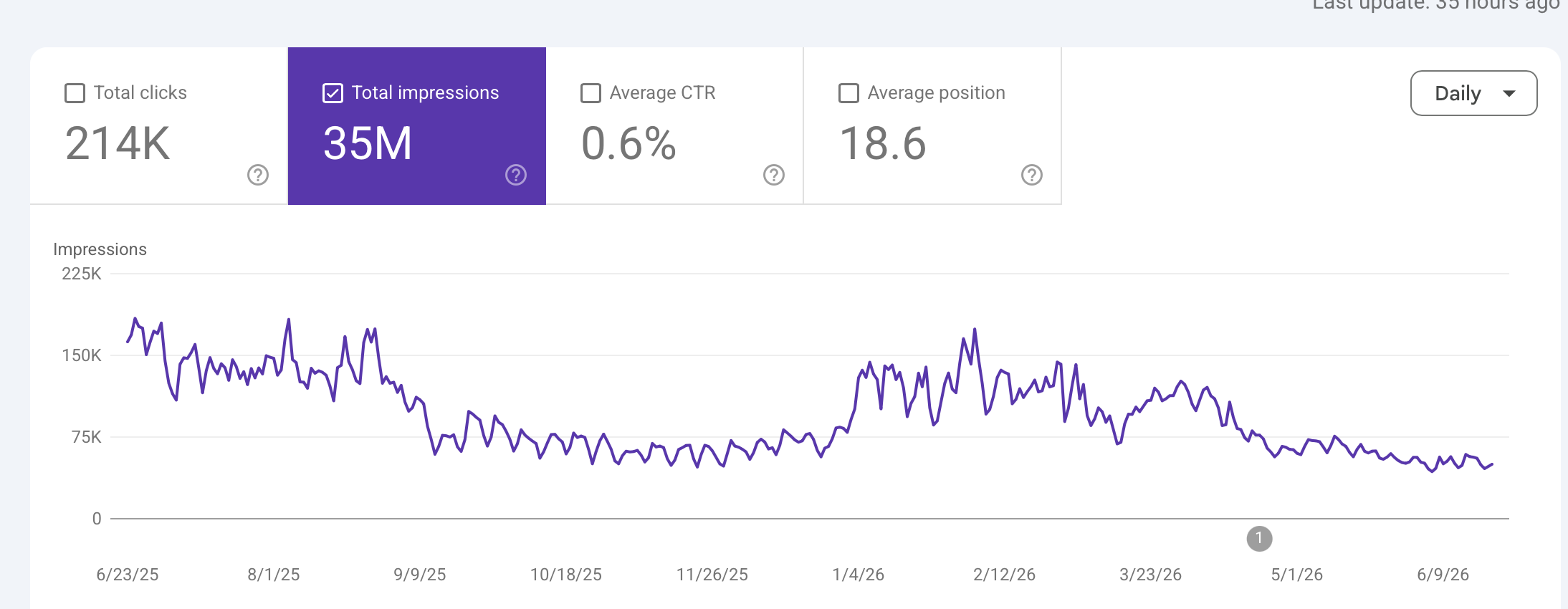
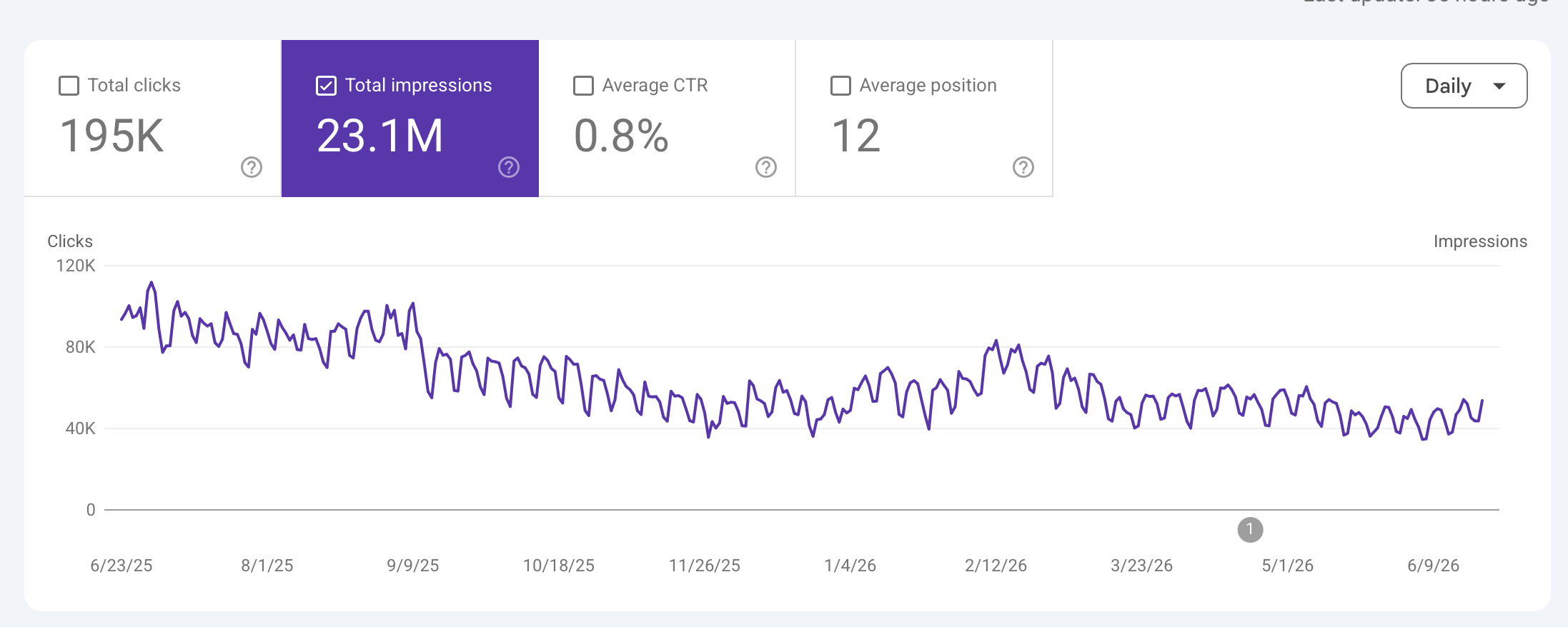
The screenshots below are not intended to prove a universal benchmark. They are examples of a broader pattern showing up across very different types of businesses and categories.
Organic traffic, search impressions, and clicks are softening in places where there is no obvious single failure. The sites are not necessarily broken. The brands are not necessarily weaker. The content is not necessarily worse.
The environment around discovery is changing.
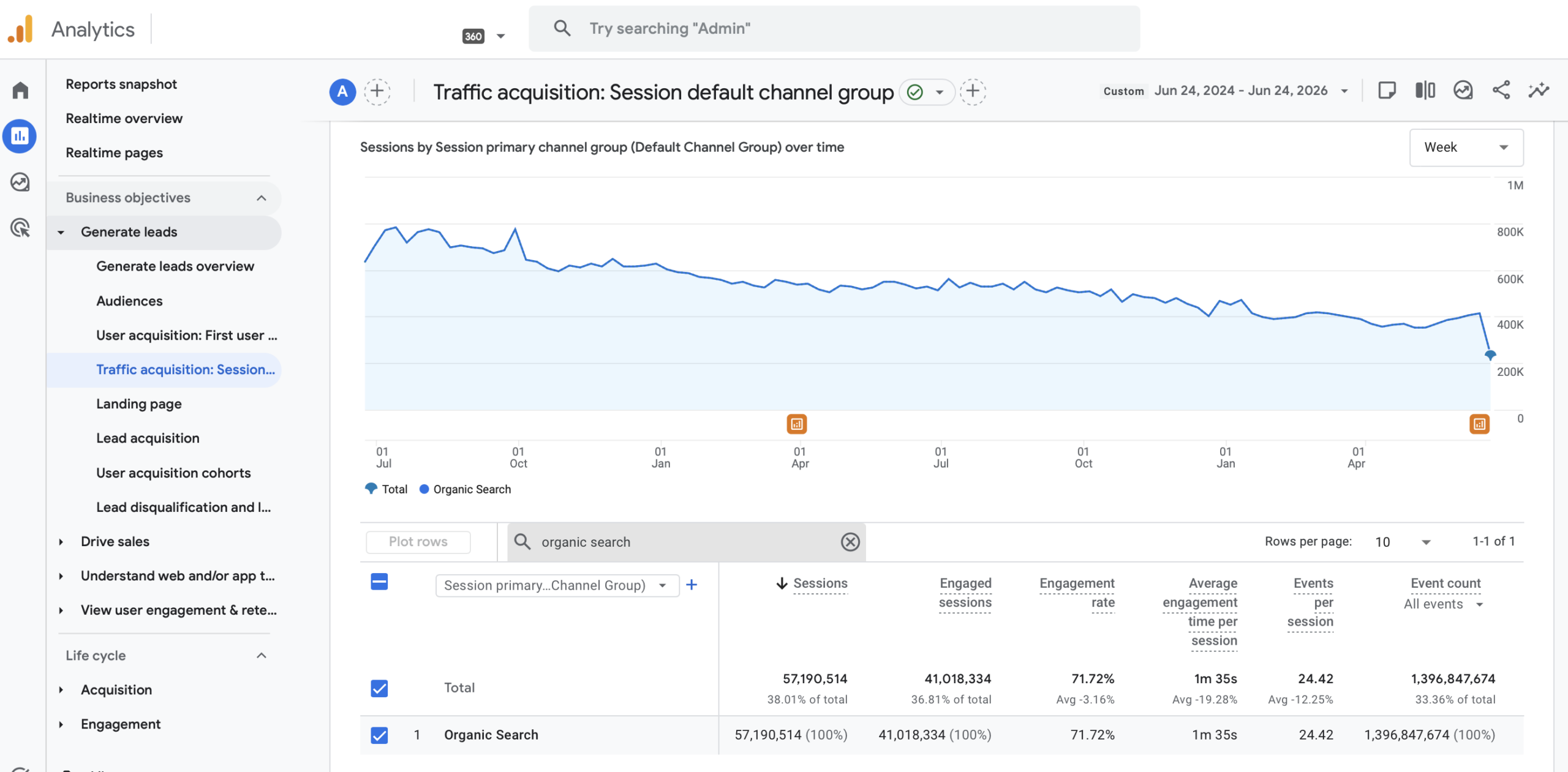
That matters because this is not just a small-business analytics problem. It is not simply that a local company installed tracking incorrectly, forgot to tag campaigns, or missed a basic SEO issue.
Even sophisticated organizations with enterprise measurement infrastructure are watching organic behavior change.
And when that happens, the question should not be, “Is Google over?”
The better question is:
What part of the customer journey is no longer visible in our current reporting?
Search is becoming less of a referral engine and more of an answer layer
Google is still enormously important. Search is still one of the most powerful consumer intent signals ever created.
But the role of search is changing.
Historically, Google’s primary job was to organize links. The user searched, reviewed options, and clicked through to the open web. Increasingly, search results pages do more of the work directly: summaries, snippets, knowledge panels, maps, reviews, product modules, local packs, comparison features, “people also ask,” videos, and now AI-generated answers.
That does not mean users stop needing businesses, websites, or content. It means more of the evaluation happens before the click.
A customer can learn the basics without visiting you.
They can compare competitors without visiting you.
They can see reviews without visiting you.
They can ask an AI tool who is best without visiting you.
They can form an opinion before your analytics ever record a session.
That is a major shift.
Pew Research Center found that Google users who encountered an AI summary clicked a traditional search result in 8% of visits, compared with 15% of visits where no AI summary appeared. 2
SparkToro’s 2024 zero-click search study estimated that for every 1,000 Google searches in the United States, only 360 clicks went to the open web. 3
Those numbers should not be read as “Google is failing.” They should be read as something more operationally useful:
The click is becoming a less complete measure of demand.
Impressions are changing too
Traffic declines are easier to notice because they show up in analytics. But the more important signal may be happening earlier.
In Search Console, impressions tell you how often your site appeared in Google search results. They are not visits. They are opportunities to be seen.
When impressions decline, the issue is not just that fewer people clicked. It may mean fewer people saw the traditional result in the first place, or fewer searches are being expressed in the same way, or Google is satisfying more intent directly on the results page.
This is where the analytics conversation needs to mature.
A decline in organic sessions may not mean your site stopped mattering.
A decline in impressions may not mean your content suddenly became irrelevant.
A stable ranking report may not mean the customer journey is healthy.
A strong website may still influence decisions that never produce a visit.
The issue is not that analytics are wrong. The issue is that analytics mostly measure what happened after someone arrived.
They are much weaker at showing what happened before the click, especially when the click never happens.
The website still matters. Maybe more than ever.
This is the part that can feel counterintuitive.
If clicks are harder to earn, it is tempting to conclude that websites matter less.
I think the opposite is true.
Your website is still one of the most important sources of truth about your business. It explains who you are, what you offer, where you operate, what you believe, what proof you can provide, what customers can expect, and why someone should trust you.
AI systems, search engines, review platforms, and comparison tools still need source material. They still need facts. They still need evidence. They still need structured, consistent, credible information.
The website is no longer just the destination after discovery.
It is part of the evidence layer that shapes discovery.
That is why a business can have fewer organic visits while its website remains incredibly important. The site may be helping train the market, support brand understanding, validate trust, inform AI answers, reinforce reputation, and influence customers who never show up as a clean organic session in GA4.
This is the central tension of modern digital marketing:
This creates a counterintuitive reality: declining traffic does not necessarily mean declining influence.
Your website can remain an important source of business information even when fewer customer journeys produce a measurable organic session.
We explored that broader measurement shift in Your Website Has Never Mattered More. Your Analytics Have Never Told You Less.
The measurement gap is getting bigger
Traditional analytics answer important questions.
How many people visited?
Where did they come from?
What pages did they view?
What converted?
What campaigns drove measurable sessions?
Those questions still matter. They are not going away.
But they are not enough anymore.
Businesses also need to understand:
Are we being included in AI-generated answers?
Are we being recommended, or are competitors being recommended instead?
Are we showing up for the questions customers actually ask?
Are we trusted in comparison moments?
Are our reviews, content, services, locations, and proof points being understood correctly?
Are AI systems describing us accurately?
Are they missing us entirely?
Those questions do not live neatly inside GA4.
They often happen before the session, outside the website, and increasingly inside answer systems that may influence the customer without sending a visit.
It is not only a traffic issue. It is a market-intelligence problem: who is being discovered, how brands are being represented, which competitors are being selected, and what is influencing the decision before a measurable visit occurs.
The old funnel is becoming harder to see
For a long time, marketers could rely on a relatively simple idea:
If demand existed, search would capture it.
If search captured it, rankings would expose it.
If rankings exposed it, traffic would measure it.
If traffic measured it, analytics would explain it.
That chain is breaking.
Demand may exist without becoming a traditional search.
Search may happen without becoming a click.
A brand may be evaluated without receiving a visit.
A competitor may be recommended before the customer ever sees your result.
A decision may be shaped by an AI-generated answer that does not appear anywhere in your analytics.
This does not make SEO irrelevant. It makes the job broader.
SEO used to be heavily focused on earning visibility in a list of links. That still matters. But now the broader challenge is understanding and improving how your business is represented across the answer layer.
That means being findable, understandable, credible, and recommendable.
Not just ranked.
What businesses should do next
The right response is not panic.
It is not abandoning Google.
It is not abandoning SEO.
It is not abandoning the website.
It is not chasing every new AI trick or acronym.
The right response is to widen the measurement lens.
Keep measuring traffic.
Keep improving technical SEO.
Keep strengthening the information and digital assets customers and machines rely on.
Keep strengthening the website.
Keep earning reviews, citations, authority, and trust.
But also start measuring the part of discovery that happens before the click.
Look at the questions customers ask.
Look at which competitors appear in AI answers.
Look at how your business is described.
Look at whether you are included in recommendation moments.
Look at whether your strongest proof points are visible to answer engines.
Look at the gap between what your business actually does and what AI systems seem to understand.
That is where the next competitive advantage is forming.
Not because Google is going away.
Because consumer behavior is moving faster than the old dashboards can explain.
The question that matters now
Organic traffic may still be telling the truth.
If visits are down, visits are down.
If impressions are down, impressions are down.
If clicks are harder to earn, that is real.
But those numbers may not tell the whole story.
They may not tell you whether customers still considered you.
They may not tell you whether AI systems recommended you.
They may not tell you whether competitors were framed more favorably.
They may not tell you whether your brand was present in the answer before the click ever had a chance to happen.
That is the shift.
The future of search is not only about whether people can find your website.
It is about whether your business is understood, trusted, compared favorably, and recommended wherever the customer asks the question.
And if fewer customers click before they decide, every business needs to ask a harder question:
How would we know whether we were included in the decision at all?