
Is GEO Just SEO? The Difference Is Smaller—and More Important—Than the Acronyms Suggest
For most of the last year, marketers have been debating a growing collection of acronyms.
SEO.
GEO.
AEO.
AIO.
Some argue that AI-driven discovery represents an entirely new discipline.
Others argue that it is simply SEO under a different name.
Google has largely taken the second position.
Its guidance for generative AI features makes an important point: the fundamentals of good SEO still matter. Websites need to be crawlable. Content needs to be useful. Technical implementation matters. Authority matters. Relevance matters. There is no secret piece of “AI schema” that suddenly replaces everything companies have spent years building.
Google is right about that.
But there is an important distinction between saying SEO remains foundational and saying nothing meaningfully changes when search becomes generative.
Those are not the same statement.
The strategic mistake would be treating this as an either-or question.
SEO is not dead.
GEO does not replace it.
But generative AI is changing how information is retrieved, assembled, presented, measured, and ultimately used by buyers.
That creates meaningful differences companies should understand.
The foundation is shared. The outcome is different.
Traditional SEO has historically optimized for a relatively understandable sequence:
A person searches.
A search engine retrieves documents.
Pages are ranked.
The user chooses a result.
The website receives a visit.
Analytics record what happens next.
That model is obviously more complicated in practice, but the basic architecture gave businesses something enormously valuable: observability.
Google Search Console could show the impression.
Search Console could show the click.
GA4 could see the resulting session.
Conversion tracking could record what happened.
CRM data could often continue the journey from there.
The connection was imperfect, but visible enough to build an entire measurement ecosystem around it.
Generative AI changes that sequence.
A user may ask a detailed question in ChatGPT, Gemini, Claude, Perplexity, Copilot, Google AI Mode, or another answer environment.
The system may retrieve information from multiple sources.
It may break a question into related subqueries.
It may compare several businesses.
It may summarize product differences.
It may eliminate options.
It may establish a preference.
It may answer follow-up questions.
And only then does the customer potentially visit a website.
Google itself describes AI Overviews and AI Mode as potentially using query fan-out, where multiple related searches across subtopics and data sources help generate the final response. That is meaningfully different from the traditional mental model of one query producing one ranked list of documents.
The website still matters.
Search still matters.
SEO still matters.
But the website visit may now occur much later in the decision process.
The owned customer journey is getting shorter
This may be one of the most important changes for marketers to understand.
Historically, a substantial portion of the research experience happened on properties the company could measure.
A consumer searched.
They visited a website.
They read several pages.
They compared products.
They reviewed specifications.
They evaluated alternatives.
They converted.
Today, some of those same decisions can occur before the company ever records a visitor.
An AI system can answer:
Which products should I consider?
What are the differences?
Which company is best for my situation?
What are the advantages and disadvantages?
What should I expect to pay?
Which option has the strongest reputation?
How does Company A compare with Company B?
By the time that person reaches the website, the research journey may already be substantially complete.
The owned experience layer has compressed.
Instead of:
Search → Website research → Comparison → Conversion
the journey may increasingly look like:
AI research → AI comparison → AI recommendation → Website validation → Conversion
Sometimes AI sends a measurable referral.
Sometimes the buyer later searches the brand.
Sometimes they return directly.
Sometimes another channel assists the visit.
And sometimes the influence that created the eventual conversion is effectively invisible.
This is why AI discovery is not simply another traffic source.
It is increasingly an influence layer before the traffic source.
We explored a closely related measurement problem in Your Website Has Never Mattered More. Your Analytics Have Never Told You Less. and Your Organic Traffic May Be Telling the Truth, But Not the Whole Story.
The website remains critically important.
What has changed is our ability to observe everything that happened before the visit.
So what is actually different about GEO?
The acronym matters less than the underlying objective.
A simple way to think about the disciplines is:
SEO: Make information discoverable, relevant, authoritative, and competitive within search systems.
AEO: Make information easy to identify and use when a system is trying to answer a specific question.
GEO: Improve the likelihood that a company, product, page, claim, or source is retrieved, understood, cited, represented, compared, or recommended inside a generative experience.
The boundaries overlap heavily.
They should.
A poorly indexed page will not suddenly become a strong AI source because someone declared it “GEO optimized.”
Weak content does not become useful because it contains an FAQ.
A company with no authority cannot engineer trust with a few technical tricks.
But the optimization target has changed.
Traditional SEO commonly asks:
Can we get this page surfaced prominently for this search?
Generative optimization adds another question:
Can a machine quickly find, understand, verify, and use the specific information contained inside it?
That is a meaningful difference.
The original academic work that introduced the term Generative Engine Optimization described generative engines as systems that synthesize information from multiple sources rather than simply return a ranked list of documents. The researchers also demonstrated that changes to content presentation could affect visibility within generated responses, although the magnitude and effectiveness varied by domain.
That does not make GEO a replacement for SEO.
It makes it another optimization layer built on top of many of the same fundamentals.
The cookie recipe problem
Anyone who has searched for a recipe online has probably experienced some version of this.
You want to know how to make chocolate-chip cookies.
You land on a page.
Before reaching the recipe, you encounter the history of the chocolate chip.
A discussion of different kinds of butter.
Several paragraphs about the author’s grandmother.
An explanation of why cookies became popular.
Storage advice.
Ingredient substitutions.
Frequently asked questions.
And somewhere farther down the page is the information you originally wanted.
There were rational reasons publishers created content this way.
For years, the economics of organic search encouraged extensive topical coverage, keyword breadth, internal-link opportunities, engagement, and comprehensive pages.
To be clear, Google has discouraged useless filler for years. Poor content was never synonymous with good SEO.
But the incentives of the search-content ecosystem unquestionably produced a lot of it.
Now imagine an AI system answering:
“How much butter do I need to make 24 chocolate-chip cookies?”
It has a different immediate problem.
It needs to find the answer.
Not admire the article.
That is where the distinction becomes useful.
AI systems benefit when information is easy to isolate and understand.
Clear headings.
Direct answers.
Logical sections.
Explicit statements.
Well-structured comparisons.
Tables where appropriate.
Strong entity relationships.
Consistent terminology.
Sourceable claims.
Accessible text.
Clean information architecture.
The issue is not that AI dislikes long-form content.
A 4,000-word article can be an excellent source.
The issue is retrieval friction.
Long content that is intelligently structured can be highly extractable.
Short content that buries every meaningful fact inside vague marketing language can be almost useless.
Length is not the enemy. Noise is.
Pages are increasingly collections of retrievable ideas
Traditional content strategy often treats the page as the primary unit of optimization.
AI introduces another useful way to think about content:
The page is also a collection of individual concepts that may need to stand on their own.
A comparison.
A price.
A product specification.
A geographic service area.
A differentiator.
A customer qualification.
A warranty.
A statistic.
A use case.
An answer to a common objection.
A relationship between two entities.
These pieces of information may be retrieved independently from the larger page.
That makes content structure more important.
A section headed:
“What is the BMW X5 towing capacity?”
followed by a direct, clearly contextualized answer is easier to interpret than burying the same fact halfway through a paragraph containing several unrelated ideas.
The second version may still be perfectly readable to a human.
The first reduces ambiguity for both humans and machines.
This is one reason chunking, semantic structure, heading hierarchy, internal relationships, and explicit language matter increasingly in AI optimization.
Technical accessibility deserves a broader definition
The same nuance applies technically.
In traditional SEO, an important question has long been:
Can Google crawl, render, and index this page?
That question remains essential.
But it is no longer sufficient by itself.
A better question for an AI-mediated web is:
Can the systems that need this information reliably retrieve and understand it?
Google is an exceptionally capable JavaScript renderer.
Not every AI retrieval system necessarily behaves exactly like Googlebot.
Important information injected only through JavaScript, hidden behind interactive components, rendered through third-party systems, or delivered through complicated tag-management implementations creates additional dependency between the source and the machine attempting to understand it.
That does not mean JavaScript is “bad for AI.”
It means unnecessary extraction friction creates unnecessary risk.
Google’s current generative AI guidance similarly emphasizes making important page content available in textual form and ensuring the site’s technical foundations remain accessible.
This is the same principle we explored in Does AI Prefer Certain CMS Platforms?.
AI does not inherently prefer WordPress, Shopify, Dealer.com, React, or another platform.
What matters is whether the implementation allows machines to accurately reconstruct what the business knows.
The clearest evidence may be what happens in the real world
We are beginning to see this distinction show up in actual performance data.
For one regional automotive retailer, Toren has helped develop a substantial library of educational content built around the questions buyers ask, the comparisons they make, and the information answer systems need to understand.
Google recently introduced a dedicated Generative AI performance report inside Search Console. It measures how often URLs from a website appear within Google’s generative AI experiences, including AI Overviews and AI Mode.
When we reviewed that report for this retailer across a three-month period, the pattern was striking.
Nine of the ten pages receiving the most generative AI impressions were pages created under this content methodology.
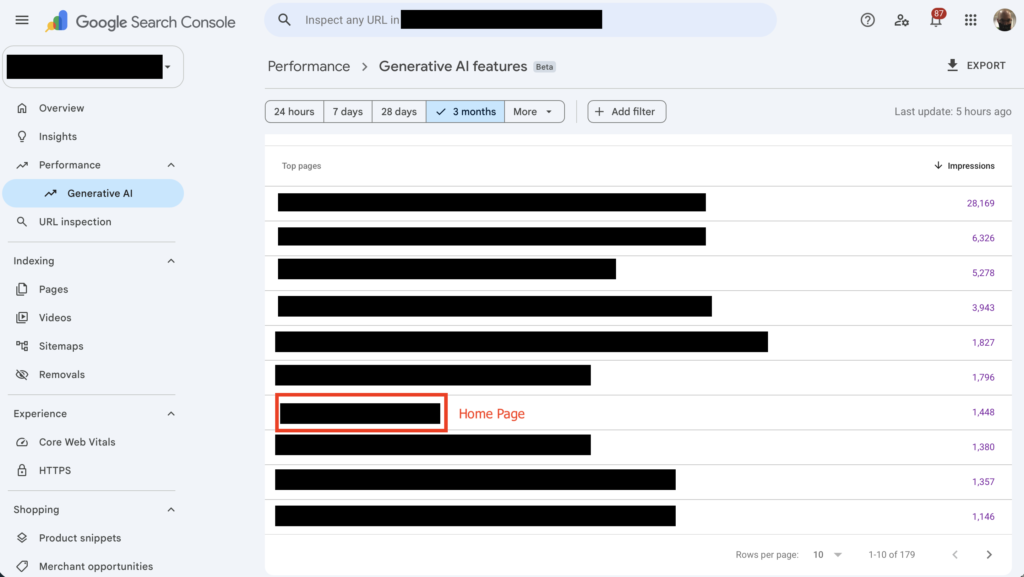
The only page in the top ten that was not part of that program was the retailer’s homepage.
It ranked seventh.
When we expanded the view:
20 of the top 25 pages were content created under the same methodology.
This is one website.
It is not a controlled experiment.
And it would be irresponsible to claim those numbers prove a universal causal relationship between a particular content methodology and AI visibility.
But the pattern is difficult to ignore.
It is particularly notable because the measurement is not coming from Toren.
It is coming from Google’s own generative AI reporting.
The homepage has many of the advantages traditionally associated with SEO.
Age.
Authority.
Internal-link prominence.
Brand relevance.
External links.
Navigation prominence.
Yet highly specific educational pages are producing significantly more generative AI visibility.
Why?
One reasonable hypothesis is that these pages contain exactly the kinds of focused, extractable information that generative systems need while answering real buyer questions.
That is not evidence that SEO stopped working.
It is evidence that different kinds of information can create different forms of visibility.
Even the search engines are creating different measurements
There is another clue that this distinction matters.
The measurement products themselves are changing.
Google now provides a dedicated Generative AI performance view in Search Console.
Microsoft has gone further in Bing Webmaster Tools, introducing AI Performance reporting that shows citations, cited pages, and grounding queries used when content participates in AI-generated answers. Microsoft explicitly describes visibility as extending beyond blue links to whether content is referenced inside generated answers.
This is important.
If traditional rankings, clicks, and impressions completely described the new environment, there would be much less reason to build separate visibility instrumentation for generative experiences.
The existence of these reports does not mean SEO and GEO are independent.
It means the same underlying information ecosystem is now producing different observable outcomes.
A page can rank.
A page can earn traffic.
A page can be retrieved.
A page can be cited.
A brand can be mentioned.
A product can be recommended.
A company’s information can shape an answer without producing an immediate website session.
These outcomes overlap.
They are not identical.
AI optimization is also more partially observable
Traditional search has given marketers decades to build increasingly sophisticated measurement systems.
Keyword rankings.
Search impressions.
Clicks.
Landing pages.
Sessions.
Attribution models.
Conversions.
Revenue.
We may argue about attribution methodology, but the underlying data is relatively mature.
AI discovery is nowhere near that level of transparency.
Some platforms provide citations.
Some provide referral traffic.
Some provide little visibility at all.
Results can change based on model version, geography, user context, conversation history, retrieval behavior, and how a question is phrased.
A customer can move from an AI conversation to a branded search.
They can open the company’s site directly.
They can visit later from another device.
They can be influenced by an AI answer without ever visiting.
That means marketers are operating in a more partially observable environment.
We can measure pieces of the journey.
We cannot yet reconstruct the entire thing.
This is one reason treating AI visibility merely as another SEO ranking report misses the larger change.
The strategic challenge is not only optimization.
It is measurement.
The website may have less time to persuade
There is another downstream implication.
If AI increasingly performs early research and comparison, the website receives a different visitor.
That person may already know the category.
They may already understand the options.
They may already know your competitors.
They may already know your general reputation.
They may already have a preferred solution.
The role of the website shifts from educating someone through the entire funnel toward validating the conclusions they have already formed.
That can shorten the owned experience dramatically.
The resulting website therefore needs to answer different questions extremely well:
Am I in the right place?
Does this company actually provide what AI said it does?
Can I trust it?
Is the information consistent?
What proof exists?
What is the next step?
This has implications far beyond SEO.
It affects messaging.
Conversion design.
Information architecture.
Brand consistency.
Structured data.
Reputation.
Analytics.
And ultimately the entire buyer journey.
That broader fragmentation is why we have argued that The AI Era Won’t Kill Search. It Will Kill Single-Channel Thinking.
The search channel is not disappearing.
It is becoming part of a larger discovery environment.
So, is GEO just SEO?
The most accurate answer may be:
Yes at the foundation. No at the edge.
SEO remains one of the most important foundations of AI visibility.
Content still needs to be discoverable.
Authority still matters.
Technical quality still matters.
Useful information still matters.
Strong brands still matter.
The open web still matters.
But generative systems are asking more of that foundation.
They retrieve differently.
They synthesize information.
They break questions apart.
They evaluate multiple sources.
They extract specific passages.
They compare entities.
They create answers instead of simply presenting documents.
And increasingly, they influence decisions before traditional analytics ever see the customer.
The mistake would be declaring SEO obsolete.
The equal and opposite mistake would be assuming that because AI systems depend heavily on search infrastructure, nothing important has changed.
Both positions oversimplify what is happening.
The practical strategy is not SEO or GEO.
It is SEO and AI optimization.
Build the technical and authority foundations that allow information to be discovered.
Then make the information itself easy to retrieve, understand, verify, compare, cite, and recommend.
And finally, build new measurement systems capable of seeing at least part of a customer journey that increasingly begins outside the company’s owned analytics environment.
The acronyms will probably continue to change.
The underlying shift will not.
Search optimization helped businesses compete for the click.
Generative optimization increasingly helps businesses compete to become part of the answer.
The companies that understand both will be better positioned for what comes next.